
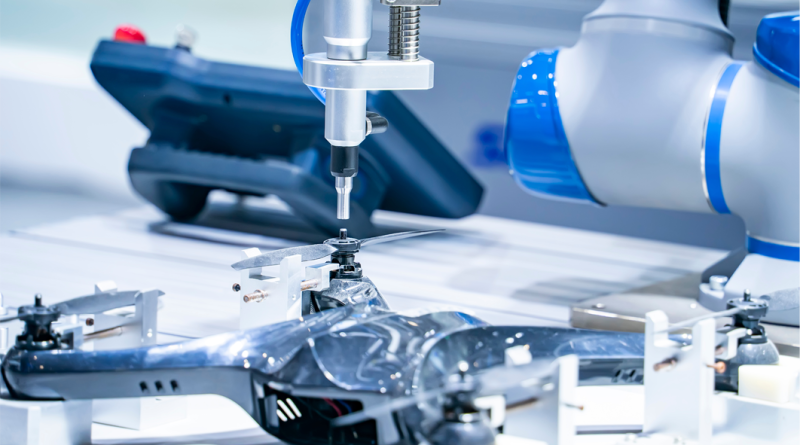
Skydio invests $3.5 billion in America’s drone manufacturing future

Subscribe to our free newsletter today to keep up to date with the latest manufacturing news.
Competition for leadership in drone technology is increasingly being decided on factory floors as much as in the skies. Skydio’s announcement that it will invest $3.5 billion in US manufacturing, research and development, and domestic supply chains over the next five years represents one of the largest commitments made by an American drone manufacturer.
The investment arrives as drones become increasingly important across defense, public safety, energy, transportation and infrastructure. At the same time, policymakers and industry leaders are placing greater attention on vulnerabilities within global supply chains, particularly in sectors where foreign suppliers dominate critical components.
The scale of the investment offers insight into the direction of US industrial strategy. The focus is no longer limited to developing advanced technologies. Increasingly, attention is shifting toward ensuring those technologies can be manufactured and scaled domestically.
Why drone manufacturing has become a national security priority
Drones have evolved from specialist military assets into essential platforms used across a wide range of industries. Utility companies use them to inspect transmission networks, emergency responders deploy them during disaster recovery efforts, and military organizations rely on them for reconnaissance and operational awareness.
This growing dependence has exposed a challenge facing the industry. Many of the components that power modern drones continue to come from overseas suppliers. Batteries, motors, magnets and electronics remain heavily concentrated in Asia, creating risks that extend beyond routine supply-chain disruption.
Recent geopolitical tensions have intensified concerns about dependence on foreign technology ecosystems. Governments in the US and Europe have become increasingly focused on ensuring that critical technologies can be sourced from trusted suppliers and manufactured within allied nations.
For the drone sector, the issue is particularly significant. Unlike many categories of consumer electronics, drones often serve dual-use functions that support both civilian and defense applications. A disruption affecting component availability can create challenges across multiple sectors simultaneously.
Domestic production is now viewed as both an economic and strategic priority. Manufacturing capability is increasingly regarded as an extension of national security policy.
Skydio’s investment reflects that reality. The company’s customer base includes every branch of the US military, public safety agencies, allied governments and major infrastructure operators. For these organizations, secure sourcing and reliable production are becoming nearly as important as flight performance and software capability.
Skydio’s expansion reflects a broader industrial policy shift
The planned investment extends beyond increasing production capacity. It represents an effort to strengthen the broader ecosystem needed to support a domestic drone industry.
According to the company, the initiative will support more than 2,000 direct jobs while generating thousands of additional positions throughout the supply chain. More than $1 billion has been allocated toward domestic suppliers and component manufacturing.
One of the most significant elements of the strategy is SkyForge, a program designed to accelerate production of critical drone components within the United States. Rather than concentrating solely on final assembly, the initiative focuses on upstream manufacturing capabilities that have traditionally been difficult to establish domestically.
The company also plans to open a manufacturing facility five times larger than its current footprint. The expansion highlights the scale required to compete in a market where production volume often influences long-term competitiveness.
The announcement aligns with a broader trend visible across multiple industries. Federal incentives, reshoring initiatives and supply-chain resilience programs have encouraged companies to reconsider manufacturing strategies that previously favored lower-cost overseas production.
Semiconductors, batteries, electric vehicles and advanced robotics have all become focal points for industrial investment. Drones are increasingly joining that list.
For policymakers, the objective extends beyond job creation. The larger goal is to establish domestic capacity in technologies expected to play a central role in economic competitiveness and national security during the coming decades.
The challenge of competing with China’s drone ecosystem
Building a domestic drone manufacturing base remains a difficult undertaking. China’s position within the global drone industry is the result of years of investment, extensive supplier networks and manufacturing scale that few competitors can match. The country’s ecosystem provides access to components, production expertise and logistics infrastructure that have helped manufacturers achieve substantial cost advantages.
For American companies, replicating that ecosystem will require sustained investment over many years. Even when final assembly takes place domestically, dependence on imported components can remain a major constraint. Batteries, motors, sensors and specialized materials are among the most challenging parts of the supply chain to localize.
Recent export restrictions and trade disputes have demonstrated how quickly access to critical inputs can become uncertain. These developments have reinforced concerns about concentration risk and accelerated efforts to diversify sourcing. The challenge extends beyond production costs and factory capacity. Companies must also compete on innovation, software capabilities and autonomous performance.
This is where companies such as Skydio believe they can differentiate themselves. Advanced autonomy, artificial intelligence and navigation systems are becoming increasingly important sources of competitive advantage. As drone hardware becomes more standardized, software and autonomy are likely to play a larger role in determining market leadership.
Success will depend on combining technological innovation with manufacturing scale, a balance that few companies have historically achieved.
What the next decade could look like for autonomous drone production
Demand for drones continues to expand across commercial, industrial and government applications. Infrastructure inspection, energy asset monitoring, construction management and emergency response are expected to drive growth alongside traditional defense markets.
Autonomous capabilities are likely to become increasingly important as operators seek systems capable of performing complex tasks with limited human intervention. Advances in artificial intelligence, machine vision and edge computing are making that goal more achievable.
For manufacturers, this creates an opportunity that extends beyond aircraft production. The future drone market is likely to encompass software platforms, data services and integrated operational systems.
The implications may also extend into adjacent sectors. Robotics, autonomous vehicles and industrial automation share many of the same technologies and supply-chain requirements. Investments made to support drone manufacturing could strengthen broader advanced manufacturing capabilities across the economy.
Skydio’s $3.5 billion commitment arrives at a moment when governments and companies are reassessing how critical technologies are built, sourced and scaled. Whether the investment ultimately reshapes the competitive balance of the global drone market remains uncertain. What is clear is that manufacturing capacity, supply-chain resilience and technological independence are becoming central themes in the next phase of drone industry growth.
Sources:
Skydio announcement
