Teconnex is diversifying beyond emissions technologies through aerospace, automation, employee ownership, and expansion plans

Manufacturing rarely stands still. Supply chain disruption, shifting emissions requirements, automation and electrification continue to reshape how companies invest and where they place their bets. For Teconnex, those pressures have become a catalyst for growth rather than a reason to retreat.
Chris Marsden knows that firsthand. He started his career as an apprentice toolmaker, then moved through engineering and leadership roles, taking over as Managing Director in March 2020 just as Covid-19 began to disrupt manufacturers everywhere. The decisions made during that time helped transform Teconnex from a business generating around £55 million in revenue into one now generating about £100 million. “Being a privately owned business meant we had the capability to make quick decisions. We didn’t have a lot of bureaucracy or red tape to go through when reacting to a very volatile environment. We actually bought too much material due to the uncertainty of this key commodity at the time, and it’s only recently that we’ve fully recovered our days in stock targets. However, this longer-term thinking gave us the ability to ramp up rapidly when strong demand returned.”

That willingness to move early continues to shape the company’s direction today, as Teconnex’s clamping and joining solutions stay embedded in emissions systems, aerospace applications, and industrial equipment worldwide. The company is investing in automation, AI, aerospace manufacturing, and energy storage as it prepares for its next stage of expansion.
Teconnex traces its roots back more than 70 years and now operates in the UK, China, Romania, Mexico, and India. Although customers often find these products hidden within larger systems, their role has become more critical as emissions standards have evolved. “We may work with a customer for two or three years before a product even launches. Knowledge of the systems, the materials, and the design-for-manufacture requirements, along with solving application challenges side by side with the customer, has established us as a technical leader in Europe. Those relationships then grew globally into China, the US, and more recently, India.” Romania followed a different logic.
Following the Brexit referendum in 2016, Teconnex opened operations in Romania to create additional manufacturing capacity and maintain access to the European market. “The UK alone wouldn’t be enough to support our ambitions, so setting up another site became a natural next step.” Today, the facility serves as the company’s automotive hub for European customers and is part of a broader strategy centered on proximity. “We need to be where our customers are, but we’ve now reached a stage where we can do that efficiently and effectively.”
When Covid lockdowns put global supply chains under strain, Teconnex’s close customer relationships created openings to win new business. By increasing inventory and relying on in-house tooling and engineering expertise, Teconnex was able to respond when other suppliers struggled to keep pace. “Customers recognized the work we were doing, and when the recovery came, we bounced back quickly. That momentum helped us grow into a £70 million business and provided the platform for our current scale of £100m.”
Growth has been accompanied by another transition: In 2024, Hexadex, the group holding company under which Teconnex sits, became 60 percent employee-owned through an Employee Ownership Trust (EOT). For Chris, however, the move formalized principles that were already embedded in the business. “Day to day, it hasn’t been as significant a change as some might assume because supporting our employees was already central to how we operated.”
Profit-sharing, engagement surveys and employee forums were already part of the company’s operating model. The EOT structure added another layer of accountability while ensuring employees play a greater role in the future of the organization. “The voice of our employees is incredibly important. They’re now shareholders in the business, and with that comes a responsibility to build something that remains sustainable for future generations.” As Teconnex looks ahead, that long-term outlook is helping inform its investment decisions, ensuring growth benefits both the business and its people.
While emissions technologies remain a core market, Teconnex is expanding its presence in aerospace, targeting further expansion with aerospace manufacturers and Tier One suppliers as part of a wider strategy to diversify. In doing so, the changes go beyond machinery and production lines. “We’re investing in a new facility that will be separated from our automotive and industrial manufacturing operation. The investment includes new machines, production lines, inspection capability, and team development to support our ambitions in aerospace over the next five years.
“Moving from automotive into aerospace requires a very different mindset and culture. We’re under no illusion about the challenge. Success will depend on sustained investment, strong leadership, long-term commitment, and the right processes and culture.”
Alongside aerospace, Teconnex is developing new capabilities in automation and AI. Some initiatives focus on business systems and workflows, while others are integrated directly into manufacturing operations. “We’re investing in software platforms and integrating AI into our existing systems. At the same time, we’re developing AI-assisted workflows designed to support employees, helping to improve productivity and strengthen compliance processes.”
On the shop floor, AI-enabled vision systems are helping Teconnex improve inspection processes by learning from product variations and manufacturing data. The expertise developed internally is also creating new avenues beyond its own facilities. “We’ve already completed our first feasibility study for an external company. The project was successful and could lead to offering those services more broadly as capacity becomes available.”
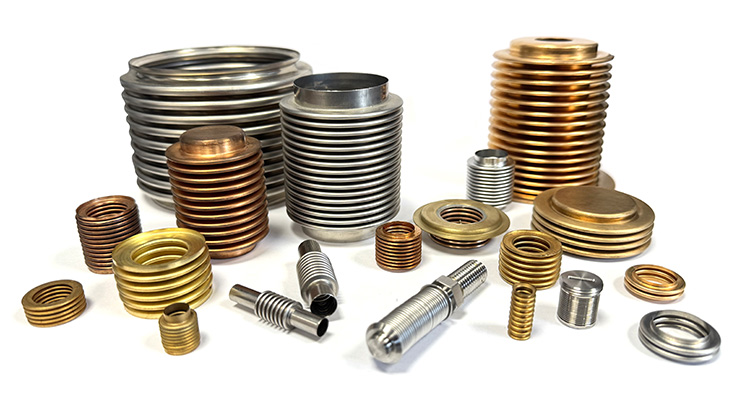
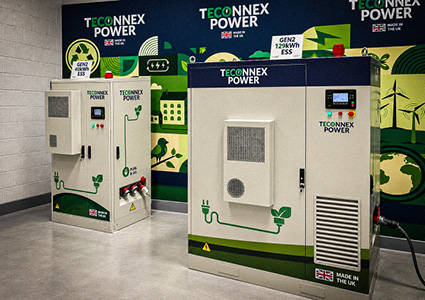
The company’s willingness to pursue new prospects extends even further through Teconnex Power, a business focused on industrial-scale battery energy storage systems. Developed from an earlier partnership, the venture has already produced and tested its first systems. It is now entering the customer engagement stage. “Where it leads remains to be seen, but we’re excited by what’s ahead.” Those initiatives sit alongside Vision30, the group’s latest five-year strategy. The plan aims to raise Teconnex revenue from £100 million to £130 million while expanding aerospace and bellows operations into significant businesses.
For Chris, the targets are less about size than ensuring the company continues to evolve alongside its customers. “One of our defining characteristics is our willingness to be wherever our customers need us. If that means building a new site to support them, we’ll do it.”
As Teconnex balances its emissions technology heritage with investments in aerospace, automation, energy storage, and employee ownership, the focus remains on creating new pathways for whatever comes next. Chris concludes, “The combination of performance and purpose is what Teconnex wants to be known for, both today and in the years ahead.”