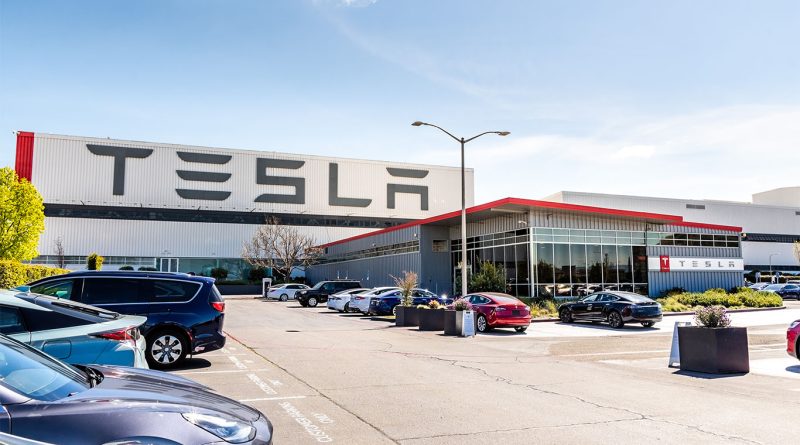
Tesla’s Terafab signals a new era in factory automation

Subscribe to our free newsletter today to keep up to date with the latest manufacturing news.
Tesla’s Terafab initiative in Austin expands its manufacturing strategy beyond vehicles into semiconductor production and AI infrastructure. The project is a joint venture between Tesla, SpaceX and xAI, designed to integrate multiple stages of chip production within a single facility.
The planned scale is significant. Tesla has outlined a $25 billion facility targeting up to one terawatt of computing power annually. The company aims to produce chips using 2-nanometer process technology, placing it at the leading edge of semiconductor manufacturing.
Terafab is expected to begin with 100,000 wafer starts per month and scale toward 1 million wafer starts per month. At that level, output would represent a meaningful share of current global semiconductor production.
The facility is also expected to produce between 100 billion and 200 billion AI and memory chips annually. These components are intended to support Tesla’s autonomous driving systems, robotics programs and related technologies.
The initiative reflects a broader shift toward vertical integration. Tesla is moving to reduce reliance on external suppliers while maintaining existing partnerships across the semiconductor supply chain.
The shift toward modular and automated factories
Terafab reflects a broader movement toward modular and automated manufacturing systems, with an added focus on semiconductor production.
Flexible manufacturing platforms allow faster adaptation to new designs and technologies. Robotics and AI improve precision and reduce downtime. These capabilities are essential in semiconductor fabrication, where production requirements evolve quickly.
Tesla’s earlier automation efforts revealed limitations, leading to adjustments in deployment strategies. Terafab suggests a more controlled application of automation aligned with production needs.
Integrating semiconductor production introduces additional complexity. Fabrication requires specialized equipment, controlled environments and advanced technical capabilities.
The initiative also reflects a convergence between manufacturing and computing infrastructure, as demand for AI hardware continues to grow.
Efficiency, cost pressure and competitive positioning
Tesla’s investment in Terafab reflects pressure from both the EV market and the expansion of AI-driven industries. Competition is increasing, and cost pressures are intensifying.
Manufacturing innovation supports efficiency gains through improved throughput and reduced reliance on suppliers. Internal chip production could reduce supply risk and improve system performance.
Tesla has indicated that existing semiconductor production capacity may not meet its long-term needs. This has influenced the decision to develop internal capabilities despite the challenges of entering the sector.
Vertical integration remains central to Tesla’s strategy, and Terafab extends this approach into advanced manufacturing.
Terafab emerges as US manufacturing adapts to supply chain risks and growing demand for advanced technologies. Automation and digital systems support domestic production, while semiconductor capabilities add strategic importance.
Tesla’s model may illustrate how manufacturing and computing converge within a single operational framework. Success could influence broader adoption across industries.
Source