

The next phase of digital transformation in electronics manufacturing. By Karthik Sankarasubbu

From wearable health devices and consumer electronics to driverless vehicles, robotics, and AI infrastructure, electronics are becoming more capable – and significantly more complex to manufacture. As manufacturing complexity continues to grow, digital transformation is expanding beyond improving factory operations to addressing challenges much earlier in the product lifecycle. The ability to scale increasingly complex products is no longer determined solely on the factory floor. It is shaped long before production begins.

The industry is changing
The electronics industry is entering a new era of complexity. The demand for products that deliver greater performance, increased functionality, and an enhanced user experience – while becoming smaller, lighter, faster to market, and more cost-effective is fundamentally increasing the complexity of electronics manufacturing. These expectations carry far-reaching implications for manufacturability, yield, reliability, and the ability to scale production ahead of competitors.
Historically, manufacturers have demonstrated their ability to solve production issues through process improvement and operational discipline. However, as product complexity continues to grow and manufacturing process margins narrow, this reactive approach is increasingly challenging to sustain. Many of the issues that emerge during the production ramp are not caused by the manufacturing process itself – they are the downstream consequences of design decisions made before manufacturing expertise is brought into product development.
The challenge is no longer about building a product that works – it is designing one that can be manufactured consistently, economically, and at scale.
Scaling products requires a new approach
For decades, Design for Manufacturability (DFM) has played a key role in helping engineering teams identify known design rule violations before production begins. These practices continue to be essential to product development and have enabled the industry to build sophisticated products of high quality.
However, increasing product complexity means manufacturability can no longer be evaluated solely through predefined design rules. Product outcomes are influenced by interactions between component characteristics, board architecture, and manufacturing process variability – interactions that are often difficult to predict during conventional design reviews and only become visible during production ramp.
Consequently, two products that both meet traditional manufacturability checks can deliver very different yield, reliability, and scalability outcomes once they enter high-volume production. This shifts the industry’s focus from validating designs against known rules to predicting manufacturing risk much earlier in the product development lifecycle. More importantly, it marks the next phase of digital transformation – not simply connecting machines on the factory floor but connecting manufacturing intelligence with engineering decisions long before production begins.
Digital transformation beyond the factory floor
For much of the past decade, digital transformation has been synonymous with connected factories, automation, and real-time production visibility. These technologies have significantly improved operational efficiency. Yet many of the most expensive manufacturing challenges still originate long before a product reaches the production line.
The next phase of digital transformation extends beyond the factory floor and into product development, enabling manufacturing knowledge to influence design decisions. Modern manufacturing environments generate vast amounts of information through inspection stations, manufacturing execution systems, quality management systems, and production workflows. Instead of using this data to understand what happened after a product was built, it is beginning to inform decisions before a product is built.
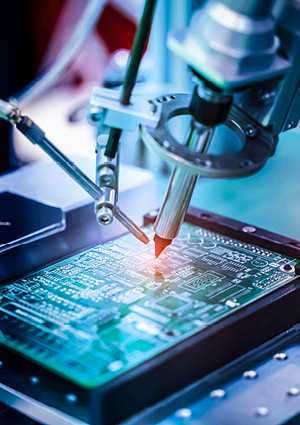
Artificial Intelligence and predictive analytics make this possible by identifying patterns across historical manufacturing data and correlating them with process capability and design attributes to estimate where manufacturing risks are most likely to occur. For example, if a particular component package, layout design rule, or process capability has consistently contributed to failures across previous products, those insights can be incorporated into future design reviews long before the first prototype is assembled.
Rather than replacing engineering judgment, this approach allows engineering and manufacturing teams to focus their expertise where predicted manufacturing risk is greatest. For OEMs and their manufacturing partners, it creates an opportunity to collaborate earlier in the product development process, reducing costly design iterations and improving production readiness.
From predicting to adopting
Predictive manufacturability offers significant potential but realizing it requires more than sophisticated algorithms. Manufacturing data often resides across multiple systems, collected in different formats and at varying levels of quality. Integrating design information with inspection, test, and production data remains one of the biggest challenges for many organizations. A practical first step is to establish a connected digital thread that links design decisions to manufacturing outcomes and standardizes how data is captured, categorized, and shared across engineering and manufacturing teams.
As this knowledge base grows, predictive analytics becomes effective at identifying patterns that are difficult to detect through experience alone. Ultimately, the value of digital transformation lies in converting manufacturing data into actionable engineering intelligence, enabling design reviews to evolve from binary pass/fail checks toward probabilistic risk prediction. Organizations that establish this ongoing feedback loop between engineering and manufacturing will be better positioned to develop increasingly complex products with greater confidence, quality, and speed.
Karthik Sankarasubbu
www.linkedin.com/in/ ksankarasubbu
Karthik Sankarasubbu is a Silicon Valley-based electronics manufacturing leader with leadership experience at Tesla, Apple, and in the autonomous vehicle industry. Writing in a personal capacity, he focuses on digital transformation, design for manufacturability (DFM), and the application of AI to improve manufacturability and production scalability for complex electronic products
.
