
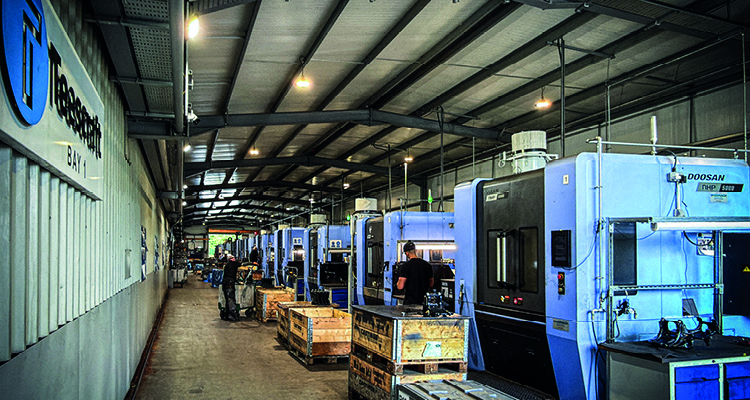
The Teescraft Group is engineering the future of British manufacturing with advanced automation and a people-first strategy

Founded in 1981 and headquartered in Bishop Auckland, County Durham, The Teescraft Group (Teescraft) has evolved into a leading Tier One precision manufacturing partner serving customers across the UK and international markets. Supporting industries including automotive, defense, energy, oil and gas, offshore, and general engineering, the Group delivers complex, high-quality components backed by a reputation for reliability, flexibility, and engineering excellence.
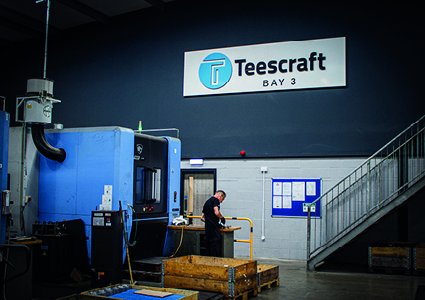
Combining iron and aluminum casting, advanced 3-, 4-, and 5-axis CNC machining, fabrication, finishing, assembly, and logistics, Teescraft provides a genuine end-to-end manufacturing solution. By controlling every stage of production, from raw casting through to fully finished, ready-to-install assemblies, the company helps customers reduce lead times, simplify supply chains, and achieve consistently high standards of quality and performance.
In 2026, Teescraft is proud to celebrate its 45th anniversary – a remarkable milestone that’s representative of more than four decades of continued customer-centric innovation. To honor this milestone, we sit down with Rob Yorke, Teescraft’s Managing Director, to learn more about the secrets behind the Group’s longevity and how its innovations are driving the future of British manufacturing today.
“For me, this journey has been incredibly personal,” Rob recounts. “I joined Teescraft in 1987 as a 16-year-old apprentice toolmaker when the business employed just five people. More than four decades later, we employ over 200 people across the Group. I’ve spent my entire career with the same company, eventually leading a management buyout in 2002. Along the way I was fortunate to have two exceptional mentors. The first was Edward ‘Ted’ Page, who founded Teescraft in 1981. Ted was an outstanding toolmaker whose craftsmanship was extraordinary. Watching him machine components was like watching a surgeon at work. His patience, attention to detail and willingness to teach shaped my early career.
“The second was Cliff Laverick, whom I met during the management buyout. Cliff helped establish Ebac in the 1970s and became my business mentor. He guided us through implementing ISO 9001, investing in our first CNC machine and, perhaps most importantly, taught me one lesson I’ve never forgotten: ‘turnover is vanity, profit is sanity, cash is king’. His advice continues to influence how we run the business today.
“Small and medium-sized businesses succeed because they remain close to their people. When you’re small, everyone knows each other, and culture develops naturally. As you grow, maintaining that culture becomes harder,” Rob adds. “That’s why building the right leadership team has been one of our biggest priorities. Technical ability matters, but so does finding people who genuinely share the company’s values and ambition. Looking back over 45 years, four factors have underpinned our success: long-standing customer relationships, a skilled and committed workforce, continuous investment in technology and capability, and the flexibility to evolve with changing markets. Those principles continue to guide every investment we make today.”
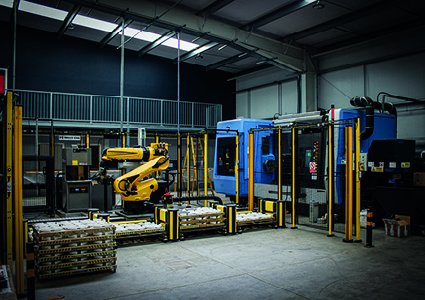
Continuous investment remains central to Teescraft’s long-term growth strategy, with capital equipment, automation, facility upgrades, and workforce development driving the business forward. A recent £3 million investment in a state-of-the-art lights-out automated manufacturing cell, for instance, marks a significant milestone, demonstrating the Group’s commitment to lean, scalable production and providing a blueprint for future expansion across additional production lines.
“This investment represents a major milestone in our automation strategy,” Rob elaborates. “Working collaboratively with one of our long-standing customers, we developed a fully automated manufacturing cell capable of delivering consistent, repeatable production around the clock. The project brought together expertise from production, engineering, quality, maintenance and management to optimize every aspect of the process – from fixturing and tooling through to in-cycle inspection, Statistical Process Control (SPC) and workflow design. The result is a highly efficient manufacturing platform that provides a proven template for future automation projects across the business.”
With the automated cell now successfully operational, the focus has shifted from proving the concept to building on its success. The project has demonstrated the tangible benefits of advanced automation in improving efficiency, consistency, and productivity, giving Teescraft the confidence to extend the approach across other areas of the business as part of its long-term manufacturing strategy.
“Now that the concept has been proven, the next phase is scaling automation across suitable product families. This involves standardized fixturing and pallet systems, automated component loading, shared tooling strategies, and enhanced digital quality monitoring, driving greater integration between machining, metrology and production planning,” Rob explains. “We’ll continue investing in automation, inspection technology and software integration to increase capacity, improve consistency, and allow our skilled workforce to focus on higher-value engineering activities.”
While technology and automation are central to improving productivity, they form just one part of the wider picture. Maintaining long-term competitiveness also depends on creating the right operating environment, with energy costs and infrastructure playing an increasingly significant role in manufacturers’ ability to invest, grow and compete on a global stage – as Rob emphasizes.
“Energy costs remain one of the biggest challenges facing British manufacturers,” he says. “Like many businesses, we’re investing in measures that improve efficiency and reduce reliance on volatile energy markets, including renewable energy generation and factory-wide efficiency improvements. However, national competitiveness also depends on long-term policy.
“Greater support for industrial decarbonization, investment in grid infrastructure, and a more stable energy strategy would help manufacturers compete internationally while supporting the UK’s sustainability ambitions. Manufacturers also have an important role to play by sharing practical experience and demonstrating that productivity and sustainability can go hand in hand.”
As Teescraft gets closer to five decades in business, its success stands as a testament to the enduring value of combining engineering expertise with long-term thinking. While the manufacturing landscape continues to evolve, the Group’s commitment to investing in advanced technology, developing its people, and building lasting customer partnerships has positioned it strongly for the future.
With automation, sustainability, and continuous improvement shaping its next chapter, Teescraft is not only adapting to the demands of modern manufacturing but helping to define them. Guided by the same values that have underpinned its growth, the company remains focused on delivering innovative, high-quality solutions that will support customers and strengthen British manufacturing for many more years to come.
“In five years, we see Teescraft becoming an even stronger and more capable UK manufacturing group,” Rob affirms. “Our ambition is to deepen our expertise in automation, digital manufacturing and program management while expanding our presence in defense, energy and other high-value engineering sectors alongside our established automotive and industrial markets.
“Investment remains central to our growth strategy. Across the Group we’re continuing to strengthen our multi-axis machining capability, foundry operations, metrology and inspection processes, factory layout and production flow, and energy efficiency, as well as various health and safety improvements. These investments improve support for existing customers while opening opportunities in new markets and strengthening resilience across all our UK operations.
“Most importantly, we’ll continue investing in our people,” he says, concluding our conversation. “Technology is essential, but it’s our workforce that defines the business. By combining skilled people with world-class manufacturing capability, we aim to ensure the next generation inherits a stronger, more resilient, and internationally competitive Teescraft Group.”
