US manufacturing output rises 0.3% as autos and AI lift production

Subscribe to our free newsletter today to keep up to date with the latest manufacturing news.
US manufacturing output rose 0.3% in October, matching September’s gain and beating the 0.2% rise economists polled by Reuters had expected, according to Federal Reserve data released on Tuesday, Nov. 17. Factory production was 2.2% higher than a year earlier.
The headline number looks steady. The detail behind it is less even.
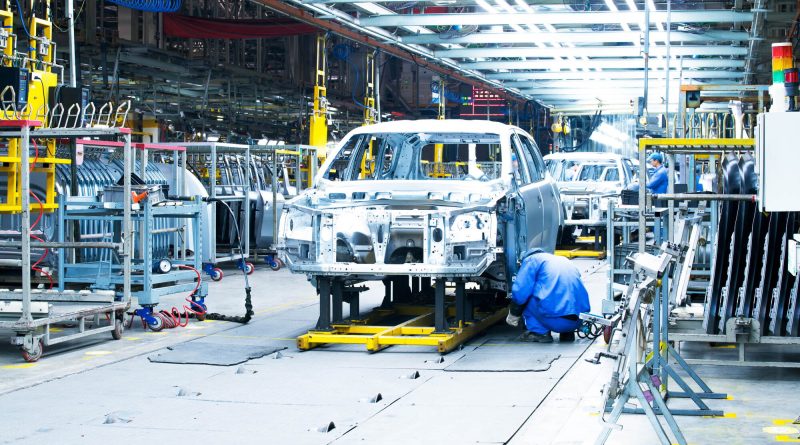
Motor vehicle and parts production jumped 4.4% in the month, after falling 2.7% in September. Strip out autos, and manufacturing output edged down 0.1%. Most of October’s gain came from a single industry winning back lost ground.
Broader industrial production, which also counts mining and utilities, fell 0.4% after rising 0.7% in September. Utilities output dropped 4.3%, which Reuters put down to mild temperatures reducing demand for heating, while mining output fell 0.8%.
One industry did most of the work in US factory production
Monthly auto output tends to swing sharply. A 4.4% rise that follows a 2.7% fall looks more like a recovery from a weak September than a new step up in production.
The annual figures make the same point. Motor vehicle and parts output was 9.5% higher than in October 2025, while manufacturing excluding autos grew 1.6% over the same period.
That gap matters for anyone reading the headline figure as a sign of a broad recovery. Outside the auto sector, factory output has grown over the past 12 months, but slowly, and in October it went backward.
The split shows up elsewhere in the data. Durable goods manufacturing rose 0.5%, carried by vehicles. Nondurable manufacturing, which covers products such as food, chemicals, paper, and fuels, was unchanged after a 0.6% gain in September. Consumer goods output and materials output each fell 0.7%.
Across most of the sector, October looked more like a pause than a recovery.
AI infrastructure is giving parts of US manufacturing a separate lift
The strongest signal outside autos came from industries tied to the build-out of AI infrastructure. Reuters linked gains in semiconductors, computers, and communications equipment to that investment.
Semiconductor and related electronic components output rose 2.2% in October and was 15.3% higher than a year earlier. The Fed’s wider group of selected high-technology industries rose 2.1% and was up 14.3% year over year. Business equipment production climbed 1.0% and stood 7.8% above its level a year earlier.
Those growth rates sit well above the 2.2% annual rise for manufacturing as a whole. They point to a two-speed sector. One group of manufacturers is expanding to meet demand for data centers and computing hardware, while much of the rest is growing slowly or not at all.
For manufacturers outside that supply chain, the question is whether AI-related spending spreads further. Data centers need power equipment, cooling systems, structural steel, and electrical components, so the demand has the potential to reach well beyond chipmakers.
October’s figures do not yet show that spread clearly. Output outside autos slipped in the month.
Capacity data shows factories have room to grow
The Fed’s capacity figures add to that picture. Manufacturing capacity utilization, the share of available production capacity in use, edged up to 76.0% from 75.9%. That is 2.2 percentage points below its long-run average.
Total industrial utilization fell to 76.4% from 76.8%, 3.0 percentage points below its 1972 to 2025 average. Utilities utilization fell 3.3 points to 70.2%, reflecting the drop in heating demand.
Plants running below their historic norms can raise output without first adding capacity. That gives manufacturers headroom if orders pick up. It also suggests demand across much of the sector is not yet strong enough to push factories toward their limits.
Manufacturing accounts for about 9.4% of the US economy, according to Reuters, and AI-related investment has become one of its main sources of support.
The October figures may not hold in their current form. The Fed plans an annual revision of its industrial production and capacity indexes on Nov. 24, bringing in new benchmark data and updated seasonal factors, so the recent monthly path could look different within days.
That leaves a question about breadth. If auto production settles after its rebound, will AI-related industries grow fast enough to keep total factory output rising, or will November’s data show how much of October’s gain rested on a single strong month for carmakers?
Source:
Federal Reserve