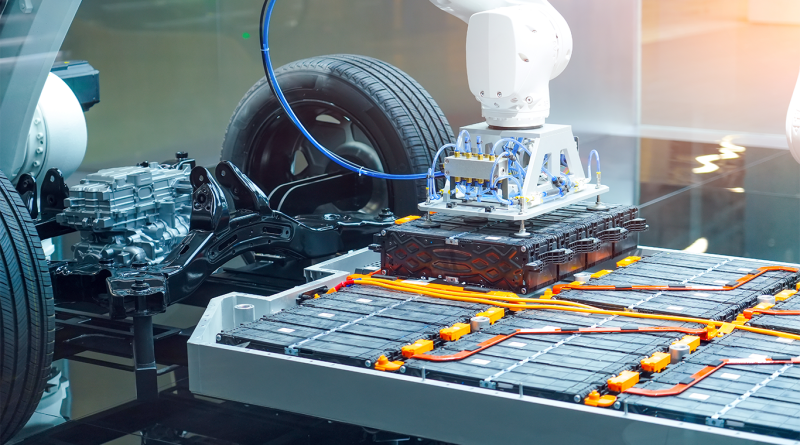
Volkswagen slows gigafactory battery manufacturing plans in Ontario

Subscribe to our free newsletter today to keep up to date with the latest manufacturing news.
Volkswagen’s battery subsidiary PowerCo is pushing back the start of operations at its St. Thomas, Ontario, gigafactory to 2029, extending a timetable that had originally targeted the first battery cells for 2027 and giving the company more time to align production with changing market conditions.
The shift adds two years to the schedule for one of Canada’s largest electric vehicle manufacturing investments, but it does not represent a retreat from the project because construction is continuing and the planned industrial scale remains largely unchanged.
Volkswagen has said the plant could represent an investment of as much as C$7 billion, or about US$4.9 billion, by 2030, with annual production capacity eventually reaching up to 90 GWh and as many as 3000 direct skilled jobs supported at full development, alongside additional employment across the regional supply chain.
The revised timetable matters beyond St. Thomas because battery manufacturers are trying to build factories that will operate for decades while the market they are designed to serve is evolving far more quickly, particularly as EV demand, vehicle platforms, battery chemistry and manufacturing economics continue to change.
The two-year extension could strengthen the factory’s production ramp
St. Thomas holds an important position in PowerCo’s global manufacturing network because Volkswagen has described the Ontario facility as the company’s first overseas gigafactory and its largest planned battery cell factory.
At full expansion, the plant’s potential annual capacity of 90 GWh would make it a significant supplier to Volkswagen Group electric vehicle production in North America, giving the company a large regional source of battery cells while reducing dependence on longer and more complex international supply chains.
The plant is based on PowerCo’s standardized factory concept and Unified Cell strategy, which are designed to create greater manufacturing consistency across several locations while still allowing battery cells to be adapted to different vehicle requirements and market conditions.
Moving the start of operations from 2027 to 2029 changes the economics of the production ramp because a battery factory does not create value simply by having its equipment installed and its production lines available.
Its financial performance depends heavily on utilization rates, production yields, material costs, customer demand and the ability to operate complex equipment at a sufficiently high volume to spread fixed costs across a large number of cells.
Bringing major production capacity online before vehicle manufacturers are ready to absorb it can create an expensive mismatch between supply and demand, leaving costly machinery operating below its intended utilization rate while manufacturers continue to carry significant fixed operating expenses.
A more gradual commissioning schedule gives battery producers more room to align cell output with vehicle programs, supplier contracts and regional demand rather than bringing large volumes online before the market can consistently support them.
This approach has become more relevant as automakers reassess the pace of their electric vehicle investments and reconsider how quickly new platforms, factories and battery programs should be introduced across North America.
The shift does not suggest that electrification has stopped, but it does show that manufacturers are becoming more selective about when individual factories should reach full production and how quickly capital-intensive capacity should be brought into service.
For suppliers, logistics operators and industrial service providers, a two-year change to battery production can affect warehouse planning, inbound material contracts, equipment commissioning, workforce requirements, transport volumes and the timing of supplier investments tied to the plant.
PowerCo can use the extra time to transfer technology from Europe
The revised schedule could have another important consequence because the St. Thomas factory that begins producing batteries in 2029 may benefit from substantially more manufacturing experience than the plant that was originally expected to begin operations two years earlier.
PowerCo began cell production at its Salzgitter gigafactory in Germany in late 2025, and Volkswagen has positioned that facility as the lead plant for subsequent battery operations in Valencia, Spain, and St. Thomas.
That structure gives the Canadian operation more time to absorb production knowledge developed elsewhere in the network before it moves into high-volume manufacturing, which could influence how equipment is configured, how quality is managed and how operating procedures are designed.
Battery manufacturing is particularly sensitive to this type of learning because improvements in production yield, quality control, energy consumption, material handling and equipment reliability can materially change the cost of every cell leaving a factory.
Experience accumulated during the ramp-up of earlier plants can therefore affect the performance of later facilities, particularly when production teams are able to identify recurring problems before new factories reach commercial scale.
Battery chemistry is evolving at the same time, creating another reason why a later production date could materially affect how the St. Thomas operation is configured when it begins manufacturing cells.
Volkswagen, PowerCo and Chinese battery producer Gotion expanded their partnership in September 2026 to cover industrial production of lithium iron phosphate, or LFP, cells and cathode active materials in Europe, with Valencia expected to become an important European production hub for LFP technology.
That agreement does not establish that St. Thomas will follow the same production strategy, but it does demonstrate how quickly Volkswagen’s broader battery plans are developing as the company evaluates different chemistries, cost structures and regional manufacturing models.
A factory that begins commercial production several years after its original design decisions were made may need to accommodate different battery chemistries, manufacturing processes, material requirements or cost assumptions from those envisioned when the project was first announced.
PowerCo’s standardized manufacturing approach is intended to make those changes easier by creating common production systems and cell formats while preserving enough flexibility to respond to changes in technology and customer requirements.
For St. Thomas, the additional two years create a larger window in which lessons from Salzgitter, Valencia and other parts of PowerCo’s manufacturing network can influence the Canadian plant before it reaches full-scale production.
The more difficult stage now involves turning large capital commitments into productive factories that can operate competitively, reach sustainable utilization levels and maintain sufficient demand over time.
Factory announcements, construction budgets and projected capacity provide an early indication of industrial intent, but long-term results depend on whether plants can reach efficient production, secure reliable customers and support supplier networks that are economically sustainable.
St. Thomas will be watched closely because its scale gives the project the potential to generate significant demand for battery materials, industrial equipment, transport services, engineering support and specialized labor across Ontario and beyond.
A slower start shifts the point at which much of that activity reaches full industrial scale, particularly for suppliers whose own investment decisions depend on when PowerCo begins operating at meaningful production volumes.
At the same time, the revised schedule may give PowerCo a clearer view of North American EV demand and allow the company to apply a larger body of operating experience from its European facilities before the Canadian plant begins its own production ramp.
Source:
CBC Canada