

Why advanced robotics demand reliable, deterministic connectivity. By Amir Bushehri

As advanced robotics reshapes modern manufacturing, connectivity has quietly become one of the most important enablers of safety, productivity and scale. Autonomous mobile robots (AMRs), automated guided vehicles (AGVs) and AI-enabled inspection systems now move materials, capture data and work alongside employees across manufacturing floors.

As robot fleets grow in number and sophistication, the wireless networks that support them are increasingly becoming a limiting factor.
For years, Wi-Fi has been the default connectivity layer inside plants and warehouses. It performs well for laptops and stationary equipment. Mobile robotics introduces a different set of requirements. Robots are not simply endpoints exchanging data. They are moving machines making rapid decisions in dynamic, high-stakes environments. When connectivity falters, the impact becomes physical rather than purely digital.
When ‘best effort’ isn’t good enough
Manufacturers deploying small pilot fleets often discover that what works for five robots does not work for 50, and certainly not for hundreds.
Traditional Wi-Fi networks face several challenges in robotic environments. Handoffs between access points can be unreliable, which may cause robots to stop or lose navigation awareness. Interference increases as more connected devices operate within the same facility. Dead zones may appear across large indoor or outdoor environments. Mobile robots that rely on VPN connectivity can experience delays while reconnecting as they move across the network. Latency fluctuations also become more noticeable as fleets expand.
When a robot loses its heartbeat connection during a handoff between access points, the system typically triggers a fail-safe stop. This behavior protects workers and equipment, but repeated stoppages interrupt workflows and reduce overall throughput.
In many manufacturing environments, robots operate alongside handheld scanners, tablets, IoT sensors and employee devices. The growth of connected equipment increases contention on the wireless network. Even small delays can affect obstacle detection, path planning and motion control. In spaces where humans and machines share the same floor, milliseconds matter.
From connectivity gaps to deterministic mobility
Advanced robotics requires a shift away from best-effort wireless performance toward predictable and consistent connectivity.
Private cellular architectures are increasingly being evaluated to support this shift. In contrast to shared Wi-Fi environments where robots compete with employee devices and general traffic, private cellular networks operate in dedicated spectrum. The separation reduces interference and limits network contention, which are common causes of inconsistent robotic behavior.
Cellular mobility was designed for seamless handoffs between cells. This capability allows robots to move continuously across large facilities and between indoor and outdoor environments without losing connectivity.
Predictable connectivity reduces sudden disconnects that lead to emergency stops. As a result, material flow becomes smoother, production timelines become more consistent, and equipment experiences less wear from repeated stop-and-go motion.
Robot-to-robot communication and fleet intelligence
Connectivity also plays a role in how robots interact with each other.
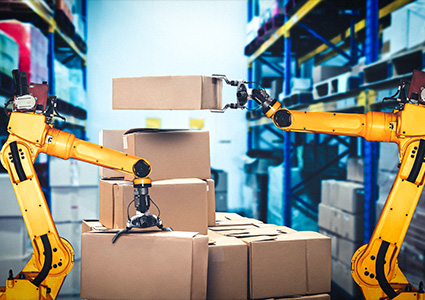
Modern robotic fleets rely on continuous coordination to optimize movements and manage traffic within aisles and production lines. Robots regularly exchange information such as location data, path updates and task assignments. This coordination allows fleets to avoid congestion and maintain efficient workflows.
Reliable wireless connectivity supports this robot-to-robot communication layer and allows fleets to function as coordinated systems rather than isolated machines.
This capability will grow more important as robotics platforms continue to evolve. New generations of industrial robots, including humanoid systems and highly autonomous assistants, are being designed to operate in shared workspaces. Rapid communication between machines allows work orders, operational updates and software changes to move quickly across the fleet, improving responsiveness and overall efficiency.
Latency and real-time intelligence
Many modern manufacturing robots rely on sensor systems such as cameras, LiDAR and AI-based perception tools.
Robots must continuously interpret their surroundings and respond in real time. A robot navigating around a pallet jack or reacting to a fallen component must process data and adjust its movement immediately.
Latency variability can slow this perception loop. Network delays or jitter introduce inconsistencies that affect navigation and control.
Low-latency connectivity supports faster response times and more consistent performance. Networks capable of maintaining latency below ten milliseconds help robots react quickly to environmental changes.
This capability becomes even more valuable when paired with edge computing. Instead of sending critical data to remote cloud platforms, robots can process information within the enterprise network.
Private cellular infrastructure integrates with on-premise systems such as manufacturing execution platforms, robotic controllers and security gateways. This architecture supports secure and responsive communication between robots and local computing resources.
Reducing reliance on cloud round-trip communication improves both responsiveness and operational resilience.
Breaking through the connectivity wall
Many manufacturers encounter a turning point when robotics deployments expand beyond early pilot programs.
As fleets grow larger, Wi-Fi networks often begin to show their limitations. Engineers sometimes refer to this stage as a connectivity wall. Network contention increases, roaming failures become more frequent and coverage gaps become more visible.
Adding more access points can improve signal coverage, but it does not fully address mobility and latency challenges.
Private cellular networks are designed to scale more predictably. As robotic fleets expand, additional robots can be introduced without redesigning the entire wireless infrastructure.
This approach supports emerging operational models such as robot connectivity as a service, where reliable network performance becomes the foundation that allows robotics automation to operate at scale.
Even small increases in downtime can have measurable effects on manufacturing operations. A one percent change in robot availability can affect throughput, delivery schedules and labor efficiency. Reliable connectivity strengthens overall equipment effectiveness and helps manufacturers protect their automation investments.
Security as a safety imperative
As robots become mobile computing platforms, cybersecurity becomes closely tied to physical safety. A compromised robot is not simply a data concern. It is a machine capable of moving equipment, interacting with workers and affecting operations.
Private cellular networks incorporate SIM-based authentication and policy enforcement aligned with zero-trust security principles. Each robot can be authenticated and managed under enterprise security policies. Network segmentation also allows administrators to control how devices communicate within the system.
Integration with existing firewalls and access control platforms helps maintain consistent oversight across the robotic fleet. For manufacturers working in regulated industries or protecting sensitive intellectual property, this additional layer of security is an important operational safeguard.
Enabling human-robot collaboration
Manufacturing environments are shared spaces where robots and employees work side by side. Consistent connectivity improves not only operational performance but also robotic awareness and coordination. Reliable network communication allows robots to maintain situational awareness, coordinate with fleet management systems and communicate intent clearly.
Removing unexpected pauses or erratic movements caused by connectivity interruptions helps build trust between workers and machines. In more complex situations, such as blocked pathways or equipment disruptions, strong uplink capacity supports video and telemetry streaming to remote operators. Centralized fleet management platforms provide visibility across all robots and allow teams to respond quickly without interrupting production.
Connectivity as strategic infrastructure
Mobile robotics is transforming manufacturing floors and logistics operations. As robotic deployments grow more sophisticated, the importance of the underlying network infrastructure continues to increase.
Connectivity is becoming a strategic component of modern manufacturing operations. Reliable networking supports automation, artificial intelligence and operational resilience. Manufacturers that invest in networking architectures built for mobility, low latency, security and scalability will be better positioned to expand robotics programs successfully.
In the race toward smarter factories, the most overlooked competitive advantage may not be the robot itself. It may be the reliability of the network that keeps those robots moving.
Amir Bushehri
Amir Bushehri is Strategic Alliance Director, at Digi International, a global technology leader empowering enterprises to build, connect, and manage the critical systems that drive their businesses. Through an integrated portfolio of managed services, intelligent software, secure connectivity, and resilient edge solutions, Digi helps enterprises monitor, update, and control assets in real time, strengthen compliance, streamline workflows, and keep distributed operations running without interruption. Since 1985, Digi has enabled organizations worldwide to modernize operations and confidently connect millions of devices.
