
Automation will scale when it becomes easier to deploy

Manufacturers have spent decades automating the tasks that are easiest to justify: high-volume, repetitive processes where the return on investment is clear and the production environment changes relatively little. The next phase is harder. Smaller batches, older equipment, limited engineering resources and changing product mixes make conventional automation more difficult to justify, particularly for small and mid-sized manufacturers that cannot redesign an entire line around a fixed robotic cell.
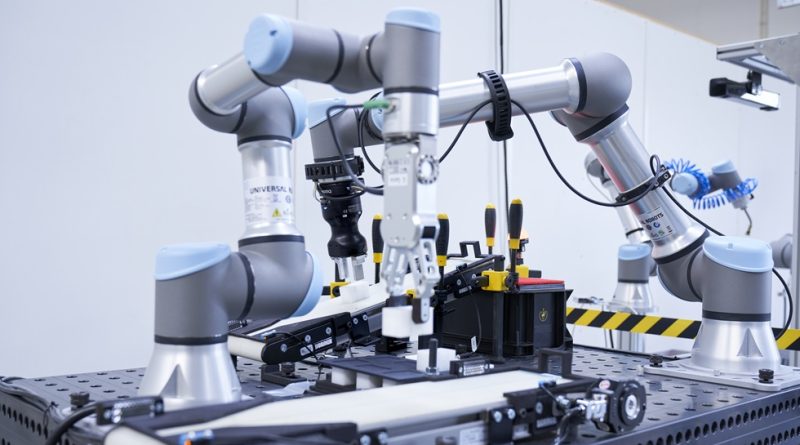
Mark Gray, UK and Ireland Manager for Teradyne Robotics, believes the biggest opportunity now lies in reducing that complexity. Teradyne Robotics brings together Universal Robots and Mobile Industrial Robots, covering both collaborative robot arms and autonomous mobile robots. For Gray, the route to wider adoption is not simply more capable hardware, but automation that manufacturers can deploy, reconfigure and eventually program without depending on specialist skills every time production changes.
Traditional industrial robots still make sense where volumes are high and the task is stable, but their economics become harder to defend when production runs shorten. Cobots changed that equation by making it easier to move automation between machines and adapt it to new tasks.
“Traditional automation has generally been quite complicated to program and is usually fixed in one position, so unless you have large volumes going through that cell, the economics do not always add up,” Gray says. “Cobots were aimed at smaller batches. They are simple to program, lightweight enough to move between machines and, if you make them compatible with a wide range of grippers, camera systems, sanding tools and other devices, you can reuse the same robot for a completely different task in the future.”
Flexible automation changes the investment case because the same robot can keep earning across different tasks instead of being tied permanently to one process. A cobot that tends one machine for part of the week and is redeployed elsewhere as demand changes can justify itself at far lower volumes than a fixed cell engineered around a single product for several years.
Flexibility changes the economics
The strongest applications are often still familiar manufacturing tasks rather than futuristic ones. Gray points to CNC machine tending as an example where a cobot can allow a small machine shop to run equipment after operators have gone home, effectively increasing the productive hours available from an existing machine. Packaging, palletizing, deburring, sanding, inspection and component handling offer similar opportunities because they combine repetitive work with a relatively clear business case.
The workforce argument is more nuanced than simply replacing manual labour. Gray describes Teradyne Robotics’ position as “robots do not take jobs, they take tasks”, particularly where work is repetitive, physically demanding or difficult to perform consistently.
“If somebody is standing at a finishing belt taking flash off an aluminium casting all day, you have to ask how much pride they can realistically put into doing that job and how consistent the quality will be,” he says. “A robot does not care. It is repeatable. Automate those dirty, dangerous and dull jobs to increase quality and reduce scrap and use the people you release from that task to do something where they can add more value, such as final inspection. Instead of inspecting one in every ten or one in every hundred products, perhaps you can inspect every one.”
Material movement presents another area where automation can remove work that manufacturers often fail to recognise as a significant drain on productivity. Production cells may be highly organised, while components still arrive because somebody pushes a trolley across the factory or leaves a workstation to retrieve parts from stores.
Gray describes applications in aerospace and filtration manufacturing where autonomous mobile robots are being used to automate those journeys. Instead of people repeatedly transporting kits or calling for forklift trucks, an AMR can collect material from known locations, deliver it to the line and return for the next task.
“The amount of time that takes is incredible when you start adding it up over an eight-hour day,” Gray says. “By automating it, people can stay in the stores making up the kits and reacting to what production needs rather than spending time walking across the factory. It also improves safety because, instead of somebody randomly travelling around the factory in a forklift truck, the AMR is navigating in a controlled way and dynamically avoiding obstacles.”
The wider implication is that cobots and AMRs cannot always be considered as isolated projects. Even in brownfield factories, manufacturers need to think about how parts are presented, how material moves between processes and where automation could fit into the production flow. Designing that repeatability into the process reduces the engineering effort required later.
The first project has to create confidence
A failed first automation project can do more damage than the lost investment because it shapes management and workforce attitudes towards everything that follows. Gray therefore argues that manufacturers with limited robotics experience should begin with a use case that combines straightforward economics with a task employees already want to see changed.
“There are generally three factors for success,” he explains. “First, it needs to be financially viable and give a relatively short payback. Second, the staff need to be happy that it is doing something they want, so we often ask them to nominate a dirty, dangerous or dull job that they do not want to perform. Third, management needs to see the value. Once you have the payback, the workforce involved and management aligned, the company is in a much better position to adopt automation and start rolling it out.”
That approach also helps explain why some smaller manufacturers can move surprisingly quickly. In a business with 60 or 70 employees, two successful robots can have a visible impact on productivity almost immediately. Gray says some SMEs Teradyne Robotics has worked with have progressed to around 20 robots without reducing headcount, using automation instead to increase output and remove unpopular tasks.
As that automation footprint grows, flexibility becomes more important than the success of any single installation. A manufacturer running batches of only 30 components cannot justify calling an external integrator every time the product changes, so the software must be simple enough for line operators or internal technicians to adjust the system themselves.
“It used to be that if you were going to automate something, you needed production runs in the tens of thousands,” Gray says. “Now we have machine-tending applications where there might only be 30 components in a batch before moving to another size or a completely different component. The key is making the software simple enough that you do not need an external contractor to come back and reprogram the system every time.”
Physical AI lowers another barrier
“With physical AI, you can link a control system to the robot and converse with it in English,” Gray says. “You can tell it the dimensions of the components; how many you want it to pick up and which machine you want them loaded into. You are telling it what you want it to do rather than programming every step. AI agents become the connection between the robot software and the people using the robot.”
Natural-language interaction changes the accessibility of robotics because it reduces the amount of specialist programming needed each time a task changes. For smaller manufacturers, that could remove one of the biggest barriers to using automation across short runs and frequently changing production.
The underlying capabilities are not entirely new. Robots have long been combined with vision systems and external computers to identify parts or respond to changing conditions. What is changing is the amount of integration required to make those components work together. Gray says unified platforms can bring the robot, vision processing and AI compute together, reducing the need to engineer connections between multiple suppliers.
AMRs already demonstrate another side of that autonomy by adjusting their route when obstacles appear, while robot arms can use vision and AI to identify the position, orientation or type of product they need to handle. The factory gains flexibility without giving up the repeatability that made automation attractive in the first place.
For Gray, production readiness remains the dividing line between useful physical AI and an impressive demonstration. Manufacturers need systems built around compatible hardware and software that have already been proven in industrial environments, not capabilities that only work under tightly controlled conditions.
“Physical AI working together as a platform means we have a vision system that we know is compatible, a processor that can run the software and a robot that can take those coordinates and perform the task,” he says. “There are many demonstrations of physical AI that look impressive, but this must be a production reality. It must build on the experience of robots already working in manufacturing.”
“I think adoption will be led by the companies that make automation easier to deploy,” Gray says. “There is still a massive untapped market. You can have a great deal of innovation, but if it must be supported by a specialist, it is not scalable. It becomes scalable when you make it available to everybody.”
The next phase of robotics adoption may therefore be defined less by what manufacturers can automate than by how easily they can put that automation to work. Simpler programming, reusable hardware, integrated AI and greater flexibility all reduce the engineering burden that has kept robotics concentrated in larger, highly automated facilities. For smaller manufacturers, removing that burden could be what finally makes automation a practical part of everyday production.
