
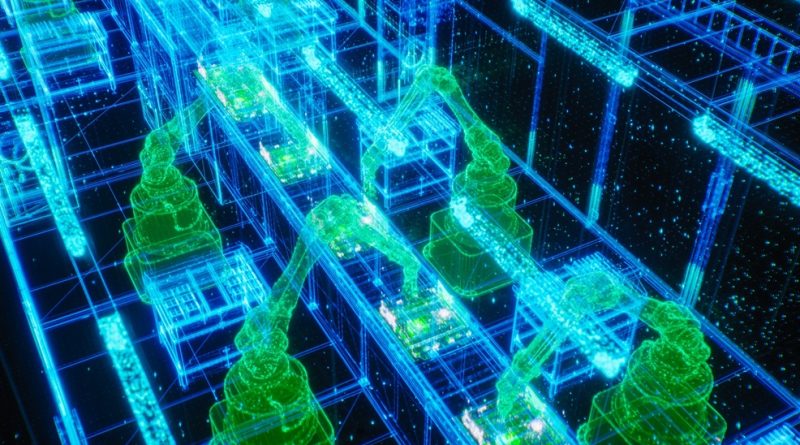
Why digital twins are finally delivering value

Digital twins have been one of manufacturing’s most talked-about technologies for more than a decade. Companies have invested heavily in detailed 3D models, simulation software and increasingly sophisticated digital representations of factories and industrial assets. Yet, for many, the technology has remained better at illustrating operations than improving them. Too often, digital twins have looked impressive in the boardroom but played only a limited role in the decisions that determine day-to-day operational performance.
Dave Philp, Chief Value Officer at Bentley Systems, believes that is beginning to change. He describes many early digital twin initiatives as examples of “digital theatre” – visually impressive models that were largely disconnected from live operational data and the systems responsible for running industrial assets. Today, however, digital twins are evolving into operational platforms that combine engineering information, real-time data and AI to help organizations predict failures, optimize performance and test interventions before they affect production.
“The digital theatre is ending,” Philp says. “Digital twins are becoming much more connected to live operational data. They’re becoming connected to enterprise systems and increasingly we’re seeing AI coming in as the decision support. They’re helping organizations predict, optimize and intervene before failures occur.”
That evolution marks an important shift in the way industry is beginning to think about digital twins. The question is no longer whether organizations can build increasingly detailed digital models. The real measure of success is whether those models improve reliability, support maintenance planning, optimize operations and ultimately help people make better decisions. As digital twins become continuously synchronized with the physical assets they represent, they are starting to move beyond visualization and become part of everyday manufacturing operations.
Digital twins need a business purpose
The technology behind digital twins has advanced rapidly, but Philp argues that technical capability has never been the industry’s biggest obstacle. Creating accurate digital representations of industrial assets is now relatively straightforward. The greater challenge is ensuring those models remain relevant once construction is complete and production begins.
For many years, digital twins were treated as destinations in their own right. A project team would complete the model, hand it over with the finished facility and move on. While those models captured valuable engineering information, they often became disconnected from the physical assets they represented as maintenance activities, upgrades and operational changes accumulated over time.
“The twin is becoming an operational system,” Philp explains. “It’s helping organizations manage performance, risk, maintenance, sustainability and resilience across the asset lifecycle. It’s no longer about finishing construction and saying, ‘We’ve built a digital twin.’ It becomes the backbone that helps people make better decisions every day.”
That shift changes the way success should be measured. The sophistication of a model, the volume of data it contains or the quality of its visualization matter far less than the operational outcomes it enables. A digital twin that helps prevent unplanned downtime or supports more effective maintenance planning will create considerably more value than one that simply presents an accurate virtual representation of a facility.
“The strongest twin is motivated by the outcomes,” Philp says. “It should always have a line of sight back to the business goals, whether that’s predictive maintenance and reliability, process optimization, sustainability or resource efficiency.”
Keeping that connection alive depends on something many early projects overlooked. Industrial assets are constantly evolving through inspections, repairs, equipment replacements and operational improvements. Unless the digital twin evolves alongside them, confidence in the information it contains quickly erodes. Maintaining what Philp describes as an “evergreen” twin, one that remains synchronized with the physical asset throughout its lifecycle, is therefore becoming just as important as creating the model in the first place.
Scaling depends on trust, not technology
The conversation around digital twins often focuses on technical capability, yet Philp believes the barriers to large-scale deployment lie elsewhere. Most manufacturers have already demonstrated that digital twins can deliver value within individual production lines, assets or facilities. Extending those benefits across an entire manufacturing network is a very different challenge.
“The biggest challenge isn’t technological,” he says. “We’ve now got technologies that are advanced and capable. Scaling is different because it requires governance, standardization and operational ownership.”
That distinction helps explain why so many digital twin initiatives struggle to move beyond successful pilot projects. Demonstrations are typically developed by dedicated innovation teams using carefully selected data and clearly defined objectives. Enterprise deployment, however, introduces a different set of demands. Information must be trusted across multiple facilities, engineering and maintenance systems need to exchange data consistently, and operational teams must have confidence that the recommendations generated by the twin reflect reality rather than an idealized model.
Without those foundations, even the most sophisticated digital twin quickly loses credibility. Poor data quality, disconnected engineering and operational systems, and inconsistent information standards all undermine confidence in the outputs. If maintenance records are incomplete or asset information varies between sites, the digital twin becomes another source of uncertainty rather than a trusted operational resource.
Philp argues that manufacturers already understand how to overcome many of these challenges because they have spent decades building repeatable production systems. “Manufacturing has embraced platforms, repeatability and product thinking,” he explains. “Digital twins have to follow the same logic. It’s about reusable information models and platform-based approaches rather than creating a bespoke digital twin every time.”
That philosophy represents an important change in mindset. Instead of treating every digital twin as a standalone technology project, leading manufacturers are beginning to view them as enterprise infrastructure capable of supporting multiple operational processes over many years. Standardized information models, common governance and trusted data become far more valuable than highly customized implementations that cannot easily be replicated elsewhere.
The same principle influences how organizations assess success. Rather than proving that the technology works, Philp believes manufacturers should focus on demonstrating measurable business outcomes before attempting to scale further. “It’s not just proof of concept,” he says. “It’s proof of value. Start small, build trust, create momentum and then expand into bigger business outcomes.”
Better decisions matter more than better models
Ultimately, the success of a digital twin depends on how people use it. While the technology creates a digital representation of physical assets, its real value lies in helping engineers, operators and maintenance teams make more informed decisions before changes are made in the real world.
That is where many early projects fell short. Too often, digital twins were viewed as engineering deliverables rather than collaborative operational environments. The greatest benefits emerge when everyone involved in designing, operating and maintaining a facility works from the same trusted source of information, allowing decisions to be tested, challenged and refined before they affect production.
“You should view the twin not as a design deliverable,” he says, “but as a real-world environment that people can understand. They can see the digital representation, but they can also see all the information behind it, contextualize it and start to make smarter decisions.”
Bentley has seen that approach deliver tangible results on one of the world’s first hydrogen metallurgy facilities in China. The digital twin brought together 29 engineering disciplines within a single collaborative environment, allowing design teams, construction specialists and operational planners to work from the same continuously evolving model throughout the project lifecycle. Rather than supporting design alone, the twin became a common decision-making platform, enabling performance validation, operational planning and safety reviews before the facility entered service.
The operational benefits extended well beyond visualization. The project reduced construction time by three years while delivering substantial reductions in carbon emissions, energy consumption and water use. Equally important, the shared digital environment improved operational readiness by allowing teams to rehearse complex activities, identify potential issues earlier and validate decisions before implementing them in the physical plant.
The project demonstrates that operational value comes from giving people greater confidence in the decisions they make before work begins. “It’s not about the technology,” Philp says. “It’s about making better decisions throughout planning, delivery and operation. The technology enables that, but only when people trust the digital twin enough to use it.”
From digital models to operational systems
For years, digital twins were judged by how accurately they represented the physical world. Increasingly, they will be judged by how effectively they improve the real one. Those capabilities are becoming expected. The real differentiator is whether a digital twin helps people make better operational decisions throughout the lifecycle of an asset.
The implications extend well beyond digital twin technology. They point towards a broader shift in how industrial companies approach digital transformation, moving away from isolated innovation projects towards operational systems that continuously improve business performance. “Organizations can’t view digital twins purely as technology projects,” Philp says. “They have to see them as operational improvement programs. The biggest lesson comes from manufacturing itself: success comes through repeatability, standardization and continuous improvement.”
As digital twins become continuously synchronized with operational data, connected enterprise systems and AI-driven decision support, their role is changing fundamentally. They are evolving from static digital representations into living operational systems that help manufacturers anticipate problems, evaluate alternatives and improve performance before disruption occurs.
The era of digital theatre is ending. The organizations creating lasting value will be those that treat digital twins not as an end in themselves, but as trusted operational infrastructure that continuously supports better decisions across design, production, maintenance and the entire asset lifecycle.
