
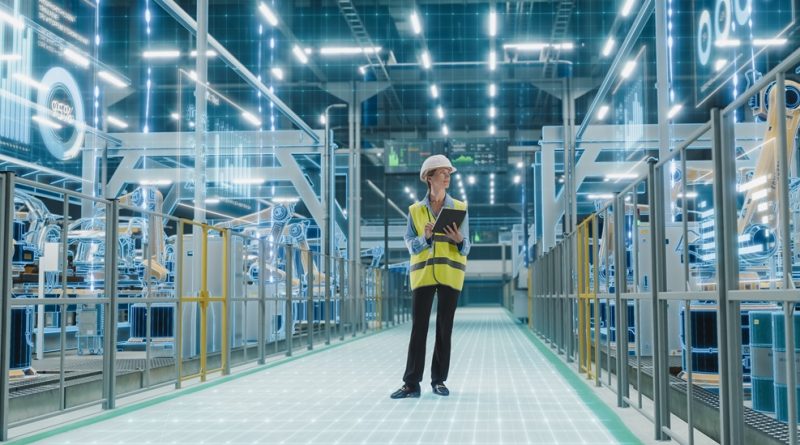
Industrial AI still needs a deterministic factory

The closer AI moves to the physical factory, the less tolerance manufacturing has for the uncertainty that makes generative models useful elsewhere. An agent can explore different production scenarios and discard a bad answer in simulation, but a control system cannot take the same liberties when it is responsible for a safety-critical process. Siemens’ emerging industrial AI architecture is being built around that divide, giving AI room to reason while keeping deterministic technology in charge where the outcome must be exact.
Mark Hindsbo, Head of Operations Software at Siemens Digital Industries, sees that as the practical starting point for industrial AI rather than a temporary limitation that manufacturers will eventually engineer away. Existing SCADA, MES and control systems still provide the reliable execution layer, while agents increasingly work across them to interpret information, test alternatives and coordinate decisions.
“An AI capability today does not operate at 10-millisecond latency to shut off an emergency valve in a chemical plant or ensure that a welding robot hits the weld point at the exact angle,” Hindsbo says. “There are a lot of things that are much better done deterministically. We do not want stochastic pharmaceutical production. If agents operated directly at today’s error rates across every operation in a car plant, the result would be significant errors.”
Siemens is placing AI above rather than instead of the deterministic layer for many industrial tasks. Agents can reason across production and suggest changes while established systems execute the operations they already perform well. That gives AI a role in decisions that currently require people to reconcile information across separate applications.
Digital twins give AI somewhere safe to be wrong
Production scheduling at Siemens’ Erlangen electronics factory provides a live test of that relationship. The plant already uses deterministic scheduling logic in Opcenter, Siemens’ MES, so the objective is not to discard what works. AI is being used around that logic to respond to conditions a fixed schedule cannot anticipate.
“The agent can optimize the schedule and look into the SAP system to see what is in stock or what was not delivered,” Hindsbo says. “It can use long-term demand as another input, but once it has a suggestion, we run that suggestion against the digital twin of the plant to see whether the configuration would work. We use the digital twin to validate what comes out of the agents.”
The digital twin becomes a proving ground rather than simply a design tool. Siemens and NVIDIA are testing agent-based planning at Erlangen, where proposed production scenarios can be checked against the virtual factory before implementation. Siemens says the approach can reduce planning costs by up to 20 percent, while a separate virtual preparation workflow for new printed circuit board assemblies can cut engineering effort by up to 85 percent.
Siemens is also embedding AI into existing applications, while Intelligence Center X sits above them as a horizontal orchestration layer for agentic workflows that may need to draw on several systems at once. It is designed to connect IT, OT and engineering information so agents can work across applications without each system having to become the center of the architecture. That becomes important when, for example, a quality issue might originate in the supplier data, the production process or the product design itself. To reason across those possibilities, the agent needs an industrial ontology that explains how the asset, product and process relate before it can decide where to look next.
AI needs ground truth more than another data lake
An ontology can tell an agent how a machine, product and process are connected, but it cannot compensate for weak or stale information in the systems underneath. Manufacturers may already have large volumes of operational data, yet different applications can still describe the same event in different ways or update at different speeds. Once AI begins reasoning across those systems, those inconsistencies become much harder to hide because every recommendation depends on the reliability of the information the agent is following.
“If the agents do not have access to ground truth, they will make things up just as people do,” Hindsbo says. “You need the building blocks in place: an MES, OT connectivity and, ideally, a digital twin that gives the agents a deterministic world model to reason against. But we do not believe you need to suck all the data into a data lake, because as soon as you do that, it starts becoming outdated.”
Leaving data in its source system also preserves controls manufacturers have spent years building around it. A PLM environment in aerospace may contain design information that only certain people are permitted to see, while a regulated life sciences system may enforce approval and traceability requirements that an AI project cannot simply bypass. Extracting the information into a new repository can separate it from those protections and from the context that gives it meaning.
Siemens instead envisages a thinner contextual layer that allows agents to understand what sits in SCADA, MES, PLM or ERP and how those records relate. The source applications remain responsible for governing the data, while agents receive defined ways to read information or act on it. That preserves the authority of the original system rather than creating another copy that immediately begins to drift away from it.
“Your ground truth needs to stay your ground truth,” Hindsbo says. “The data should remain in the governed, controlled systems, while the agents are given the appropriate actions to operate across them. You also need to make sure proprietary information does not travel back into models and become training data.”
Control over those actions becomes more important as AI moves closer to physical production. Hindsbo uses the idea of a harness: agents need boundaries around what they are allowed to do and a traceable record of the actions they took. For many current use cases, Siemens still expects a person to approve a recommendation before it changes the process.
The dashboard is no longer the destination
Industrial IoT spent years promising manufacturers visibility, but a dashboard still leaves somebody responsible for working out what the signals mean. Operators may know that a process is drifting without having the time or experience to identify the cause while production continues around them. Siemens is starting to move that interpretation into the applications themselves.
Siemens’ Insights Hub was originally built around the familiar industrial IoT model of connecting machine and process signals, then turning them into dashboards that people could interpret. The addition of a copilot starts to move that model from visibility toward diagnosis, allowing the system to compare current behavior with previous events and investigate likely causes.
Hindsbo gives the example of a recurring fault pattern that had previously been traced to a clogged nozzle, where the system can recognize similar signals and use that earlier incident as part of its reasoning rather than simply flagging another anomaly for somebody to investigate.
“The system can look at what happened the last time we had this issue and recognize that we seem to be getting the same signals,” he says. “It can identify that the previous problem was a clogged nozzle and suggest the remediation. We are putting that logic inside the existing systems so the system itself becomes more intelligent and can start reasoning around what it is seeing.”
Where that reasoning runs depends on the job. Factory-level analysis can tolerate cloud latency, but robot vision or decisions close to a PLC cannot wait for a round trip to a remote data center. Siemens is seeing more local compute on the shop floor where workloads demand millisecond response or production must continue if cloud connectivity disappears.
Brownfield equipment does not automatically exclude plants from this architecture. Siemens’ OT connectivity can reach back into machines around 30 years old, while isolated assets can often be brought into the data environment with additional sensing. The harder question is whether the plant has enough consistency and trusted information for an agent to make useful decisions once it is connected.
Hindsbo advises manufacturers to assess that readiness before pursuing the most ambitious autonomous use cases. Some AI workloads are mature enough to deploy now, while others still require specialist safety frameworks and expertise that are not widely available. Knowing where experimentation ends and dependable industrial practice begins is becoming part of the deployment challenge.
General-purpose AI may be increasingly capable, but it does not arrive knowing how a machining process behaves or what a life sciences control system is permitted to do. Hindsbo sees domain knowledge as one of the constraints on how quickly industrial AI can scale. The opportunity is to give experienced manufacturing people greater reach rather than assume the model can replace what they know.
“The old garbage in, garbage out rule is still true, except now you have the opportunity to produce garbage ten times as fast,” Hindsbo says. “AI lets domain experts scale themselves massively, but you still have to pair AI expertise with people who understand the shop floor. The technology is increasingly available. The people who know how to employ it properly are not yet available everywhere.”
For now, the industrial AI operating system is less a replacement for manufacturing’s existing architecture than a new way of making it work together. Agents can reason across a broader operational picture while digital twins challenge their proposals, and deterministic systems remain in control where uncertainty is unacceptable. Industrial autonomy will depend not on freeing AI from those constraints, but on making the constraints part of the intelligence.
