
Industrial AI is moving from automation to orchestration

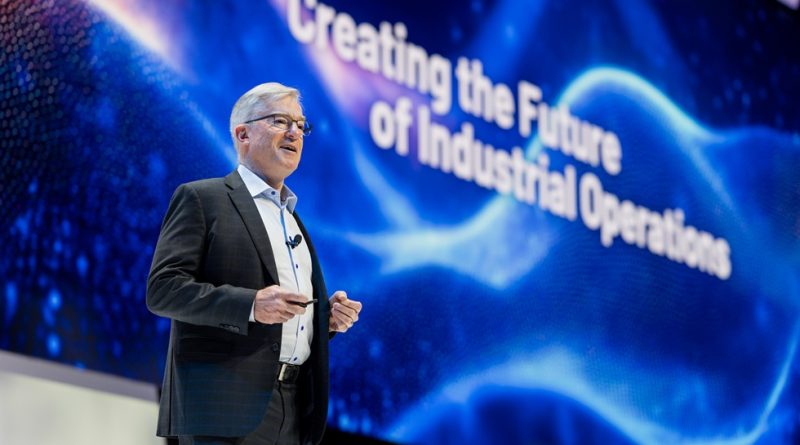
The paradox of modern manufacturing is that every new layer of automation can remove a manual task while adding another system, data stream or dependency that somebody still must coordinate. Factories have become more capable at the machine level while growing harder to manage as a single operating system, particularly when production must respond quickly to disruptions or changing priorities. Speaking at Rockwell Automation Fair 2026 in Boston, Rockwell Automation Chairman and CEO Blake Moret argued that the next industrial breakthrough will depend less on automating another isolated task than on making that accumulated complexity behave coherently.
Manufacturers are trying to improve performance while simultaneously building greater resilience into operations and meeting rising expectations around safety and sustainability. Those demands increasingly collide inside engineering and production environments that were never designed to adjust as one. Moret believes AI has reached the point where it can begin reducing that coordination burden rather than simply adding another technology layer.
“At the end of the day, I think our biggest challenge and opportunity is to simplify that complexity,” Moret says. “We need systems that can be designed with less risk, commissioned faster and operated more effectively with less unplanned downtime. AI has a big role in simplifying that complexity, and I think that is probably the single biggest opportunity we have to introduce artificial intelligence into our systems.”
Autonomy starts with orchestration
Rockwell is using its own manufacturing network as a proving ground for that vision. The company’s Singapore facility has joined the World Economic Forum’s Global Lighthouse Network, while Moret pointed to more than 30 percent higher output per employee as evidence that digital technologies can change plant performance when they are deployed at scale. Similar work is underway at Rockwell’s Twinsburg, Ohio, operation, and the company plans to apply the same thinking at its new million-square-foot site in New Berlin, Wisconsin. “We are first and foremost a manufacturer,” Moret says. “What better place to try out our technology and that of our partners than in our own facilities?”
A production line can contain advanced autonomous equipment and still require people to coordinate what happens between individual assets. Local intelligence may improve the performance of one machine, but the harder challenge begins when upstream and downstream decisions need to adjust together as conditions change. Moret sees that as the point where autonomy must expand beyond the machine.
“We see equipment operating autonomously and seamlessly integrating into a highly orchestrated production system,” Moret says. “It can anticipate needs and learn along the way from the data it creates. The goal is to optimize production, support sustainability goals and accelerate growth with greater agility.”
Digital engineering is part of that shift because manufacturers cannot afford to discover every integration problem after equipment reaches the plant. Moret highlighted simulation models that can be used to test processes before physical commissioning and then reused as operating requirements change. The value is not simply faster engineering; it is the ability to reduce risk earlier in the lifecycle and preserve a model of how the system is supposed to behave.
Machine builder Angelini Technologies illustrates the direction. Moret described the company’s use of Rockwell technologies including FactoryTalk Optix and Emulate3D to simulate high-speed production machinery before customers begin physical trials, reducing the need to send teams onsite for extended commissioning work. Remote validation became particularly important during the pandemic, but the approach has remained because it can shorten commissioning and expose problems before they become expensive physical changes.
AI must fit the industrial system
Mining stretches the autonomy problem across a much larger physical footprint than a production line. A decision at the pit can affect processing or logistics further downstream, while the number of systems and operational teams involved multiplies quickly. Moret pointed to Rockwell’s work with BHP as an example of how industrial automation is moving into decisions that span an entire value chain.
“The important part is being able to make decisions across the entire span of operations, from pit to customer,” Moret says. “That means mining, processing and logistics continuously orchestrating across those areas. Because of the convergence of IT and OT, companies like Rockwell are now right in the middle of conversations that in the past might have been more the domain of ERP providers.”
The BHP work also changes the role of the technology supplier because autonomy cannot be designed as an isolated control project. Rockwell is contributing automation and control expertise to a roadmap that must reflect how a mining business operates, including constraints that sit outside any individual technology platform.
“BHP brings decades of experience in mining, and that domain expertise remains important even in the age of AI,” Moret says. “We bring our technology and our understanding of control systems. Together, that establishes the blueprint for becoming progressively more autonomous over time.”
Rockwell is taking the same principle into engineering workflows through FactoryTalk Conductor, which Moret described as a way to coordinate AI agents across automation tasks. Rather than asking an engineer to move manually between tools, the platform can begin with a natural-language description of the task and coordinate the agents and software required to create or modify parts of the automation project. Moret also highlighted support for NVIDIA Nemotron open models, including the option to run agents locally where manufacturers want tighter control over data, infrastructure and ongoing cloud consumption.
Industrial AI is also being judged by a different standard from consumer AI because useful output must fit the engineering environment in which production already runs. Generating code or answering a question is only part of the job when the result must respect existing standards and operate reliably inside an industrial workflow. A capable model that sits outside those controls risks becoming another disconnected tool for engineers to manage.
The factory becomes a coordinated system
The production environment Moret describes includes fixed automation, mobile robots, manufacturing execution systems and connected-worker applications that historically evolved in separate domains. Bringing them into a more autonomous operating model creates a systems problem that cannot be solved simply by improving any one component. Coordination across those technologies becomes part of the production architecture itself.
“That integration is always where the difference lies between successful and not-so-successful projects,” he says. “We are expanding the opportunity across the production environment to create easier integrations, including bringing together fleet management for mobile applications, MES for traditional fixed automation and the workflows of people through connected-worker strategies.”
Autonomous material movement shows how quickly machine-level intelligence runs into that wider systems problem. A mobile robot can navigate a facility without being told how every wheel should turn, but that does not make the production system autonomous. It still needs to know what material is required, where it should go, which production order has priority and how its movement affects other equipment and people.
Any discussion of autonomous operations quickly raises the question of what remains for the people already running the plant. Moret does not describe a factory in which human contribution disappears as machines gain capability; instead, he places a different value on where human effort should be spent as routine coordination becomes more automated.
“We want to free people from the rote tasks that are not necessarily their highest purpose,” Moret says. “That allows us to use people’s creativity and innovation to make even better systems.”
Industrial autonomy is emerging less as a single technology than as a change in how factories are designed and operated. AI can simplify engineering, models can reduce commissioning risk, and mobile and fixed automation can be coordinated around common production goals while local agents work within industrial systems rather than outside them. The challenge for manufacturers is to connect those capabilities without creating another layer of complexity in the process.
For Moret, the factory of the future is therefore not simply one with more robots, more software or more AI. Its defining characteristic is the ability to make those technologies behave as a coordinated operating system, learning from the data they create while giving people a clearer and more manageable way to design, run and improve production. That shift from isolated automation toward orchestration is where Rockwell believes the next gains in industrial performance will be found.
