
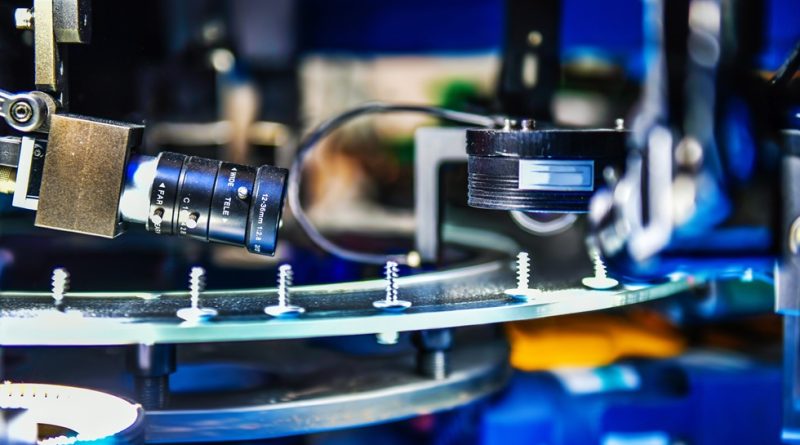
Machine vision moves beyond the camera

Manufacturers have spent decades improving machine vision by refining cameras, lighting and optics. Those elements remain essential, but as inspection moves into more variable products, AI-enabled quality control and robotic applications, the harder question is increasingly what happens after the image is captured: how software interprets it, how reliably the model performs under production conditions, and whether the result can trigger the right industrial action.
That shift in emphasis does not make the camera less important, but it does give software a much greater role in determining what can be achieved from the image. Christian Eckstein, Product Manager for the Deep Learning Tool at MVTec, says AI can sometimes reduce the demands placed on the hardware itself. “With many deep learning applications, you can use lower resolution and sometimes cheaper cameras,” he says. “If what you are looking for is still visible, that can be enough. The AI does some of the lifting that the camera had to do in the past.”
That flexibility has limits because image quality still must preserve the feature being inspected, particularly when manufacturers are looking for very small defects. What has changed is the range of problems software can tackle once the image reaches the vision system, especially where conventional rules struggle to describe the variation found in real production.
When fixed rules stop being enough
Where quality depends on judgement rather than a fixed numerical threshold, conventional vision systems can struggle to produce consistent results at production speed. “The strength of deep learning is in problems where the result does not always look the same,” Eckstein adds. “You can give the expert example images and let the AI learn from those examples instead of requiring an explicit instruction for every characteristic.”
The inspection chain itself rarely depends on a single algorithm from the raw image through to the final pass-or-fail decision. Different techniques can perform different jobs, particularly when AI is being used to identify something that still needs to be measured or assessed against explicit production criteria.
“One customer told me that they do not have a single AI vision solution that does not also use traditional machine vision,” Eckstein continues. “There is almost always some preprocessing or post-processing. The AI may segment the defect, but afterwards you still must measure it and decide whether its size, shape or other characteristics are acceptable.”
A pharmaceutical inspection project at Aspen’s Notre-Dame-de-Bondeville site in France illustrates that hybrid approach. The automated system captures up to 14 images of each filled ampoule, uses deep learning-based semantic segmentation to detect foreign particles in the liquid, and applies classical methods such as matching and blob analysis to other checks including fill level, color and closure condition. Requiring a suspected particle to appear in a defined number of images also helps reduce false positives, showing how robust inspection can depend on the complete vision strategy rather than a single AI model.
Building that capability is only part of the challenge. Once a vision system leaves development and begins operating continuously on a production line, the controlled assumptions behind the model are exposed to the variability of the factory itself.
The factory is harder than the proof of concept
Conditions that appeared stable during development can change subtly between machines, lines and sites, creating problems that were not apparent during the original validation.
“Customers often set up a production line in one country as a pilot and then scale it to other sites, and it does not simply work in the same way,” Eckstein says. “The camera may be slightly different; the lighting may be different and even the parts may vary more than expected.”
Lighting is among the most common causes of difficulty, while anomaly detection can be especially sensitive because it is specifically designed to identify anything that differs from the images used for training. MVTec has responded with continual learning capabilities that allow classification models to be adjusted on the shop floor as new variations appear, but local adaptation still must sit inside a wider model-management process.
Eckstein describes two feedback loops to manage that change over time. A faster loop at the machine can incorporate edge cases, lighting changes or product variants, while a slower loop sends production images back to the development team for more comprehensive retraining. Rather than assuming a validated model will remain unchanged for the life of a production line, manufacturers effectively must treat model maintenance as another engineering discipline.
Choosing the right model therefore means judging it against the realities of the production environment, not simply comparing headline performance figures. “You can have a model with two or three percent more accuracy, but if it takes minutes to process one image it is absolutely impossible to use in an industrial setting,” Eckstein says. “You have to select models that work in your environment, so there is always a trade-off.”
Training data presents another practical constraint because manufacturers may not have representative defect images when a new inspection process is being developed. Unsupervised anomaly detection can reduce that burden by training primarily on good images, while emerging few-shot techniques are pushing toward models that can adapt from much smaller datasets. Eckstein cautions that some of the most extreme few-shot approaches, using only a handful of images, remain research rather than established industrial technology.
From inspection model to production system
As machine vision spreads across production lines, managing models can become as important as building them. Manufacturers may have training environments, cloud-based image stores, development systems and multiple runtime deployments at the edge, creating a need for consistent control over data, models and software without sacrificing the response times required at the machine.
Research is simultaneously moving toward smaller models that can reduce inference time and memory requirements while giving up relatively little accuracy. That makes edge deployment more practical for applications operating within tight cycle times, while much larger foundation models continue to stretch expectations of what vision software may eventually be able to understand.
For most production inspection applications, however, finding the defect is only part of the job. Machine vision must connect with the wider automation architecture so that its result can reach a PLC, robot or other control system and influence what happens to the product or process rather than simply presenting another piece of information on a screen.
This is where the original focus on cameras becomes increasingly inadequate as a way of thinking about industrial vision. The camera remains the connection to the physical world, but manufacturers also need a controlled route from image acquisition through interpretation and model management to an operational response.
The next change may be less about how machine vision interprets images and more about how engineers build and configure the systems themselves. “I think that in a few years, most of the programming of a machine vision solution will also be done by AI,” Eckstein concludes. “The expectation will be that I describe in a few sentences what I want to do, and the software helps create the solution.”
Cameras, optics and lighting will remain critical because software cannot recover a defect that was never captured clearly enough to see. The bigger change is happening around the image, as manufacturers combine AI with deterministic vision, maintain models as production conditions evolve and connect visual intelligence to the systems responsible for deciding what happens next.
