
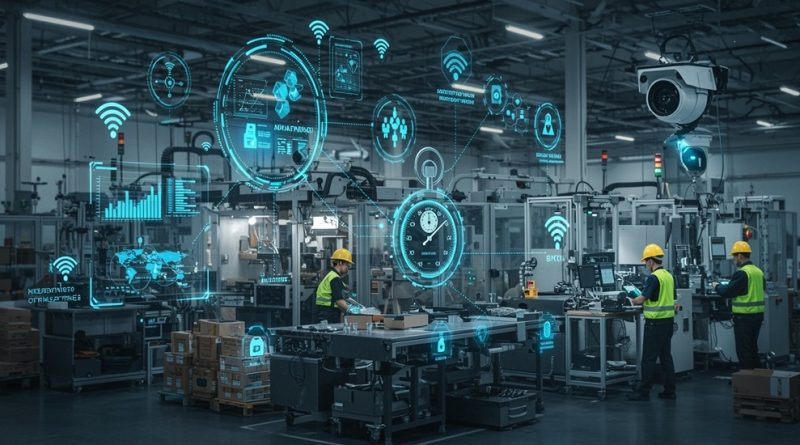
The factory does not work the way you think it does

Manufacturers have spent the past few years investing heavily in AI, yet many projects continue to struggle when they move beyond pilots and into operational deployment. While discussions often focus on data quality, infrastructure and technology platforms, Toby Mankertz, Manufacturing Industry Director at Columbus UK, believes many organisations are overlooking a more fundamental challenge. Before manufacturers can successfully deploy AI at scale, they need to understand how work is performed across their operations.
“When operations or top management come to the shop floor to implement manufacturing AI, they realise the reality of operations is not the same as the design of the operation,” Mankertz says. “For me, it starts with how well-defined processes are and, more importantly, how closely people follow them. There are an awful lot of workarounds that exist in business, and those become very visible when organisations start trying to deploy AI.
“I speak to organisations that believe they are ready because they have documented processes, compliance frameworks and established systems. The challenge is that documented processes and actual processes are not always the same thing. The way people really work evolves over time, and those differences create problems when businesses try to automate decision-making or scale AI initiatives.”
Mankertz believes many organisations spend significant time assessing technology readiness while paying far less attention to operational readiness. The result is that AI projects frequently expose inconsistencies that have existed within the business for years but have never been properly addressed.
“Many organisations are still working with processes that have evolved over decades,” Mankertz continues. “People create workarounds, departments develop their own ways of operating and sites adapt to local requirements. Those things are not necessarily bad, but they do create variation. When you introduce technology that relies on consistency and repeatability, those differences suddenly become much more obvious.
“That is why culture and user adoption remain so important. You can have the best systems in the world, but if people do not use them in the way they were intended, you are not going to achieve the business value you expected. We see that in digital transformation projects generally, not just AI projects.”
Brownfield manufacturing
The challenge is compounded by the fact that most manufacturers are not building AI strategies from a blank sheet of paper. Unlike newer organisations that can design workflows around modern technologies, manufacturers are typically trying to modernise complex operational environments while maintaining production.
“Very few manufacturing organisations are genuinely AI-native. Most are operating in what I would describe as brownfield environments,” Mankertz adds. “They are trying to take advantage of new technologies while also dealing with existing systems, existing processes and existing ways of working. Those processes were never designed with AI built into them.
“What we have seen over the last few years is a lot of bolt-on rather than built-in thinking. Organisations have been exploring where AI might fit within existing operations. At the beginning there was so much opportunity being discussed that it was difficult for many manufacturers to know where to start.”
That early enthusiasm is now giving way to a more measured approach. Manufacturers are becoming more selective about where they invest and more demanding about the outcomes they expect.
“There seems to be much greater rationalisation around the use cases that genuinely make sense,” Mankertz says. “Whether we are talking about process manufacturing or discrete manufacturing, organisations are becoming clearer about where AI can create value and where it cannot. The conversation is becoming less about experimenting with everything and more about solving specific business problems.”
At the same time, manufacturers are grappling with an explosion in the amount of data available across their operations. Connected equipment, sensors, machine vision systems and industrial software platforms are generating unprecedented volumes of information. Yet Mankertz argues that collecting data is no longer the challenge.
“We have access to huge amounts of operational data today,” Mankertz explains. “Machine data, sensor data, production data, image data and video data are being generated continuously. The issue is not whether we have enough information. The issue is whether we can process that information in a meaningful way and turn it into actions that improve performance.
“A huge proportion of the data organisations generate remains dormant. It is collected, stored and retained, but it is not necessarily analysed or acted upon. The challenge is moving from information to action.”
Mankertz recalls a recent discussion around autonomous driving in Formula One that highlighted the complexity of translating data into effective decisions. “I was listening to Toto Wolff discussing why robots are not driving Formula One cars,” he says. “The answer was that they are significantly slower and they crash more often. There are simply too many variables. Track conditions, tyre conditions, weather, traffic and countless other factors all need to be considered at the same time.
“In manufacturing, the challenge is obviously different, but the principle is similar. The more variables that exist within an operation, the harder it becomes to process information quickly enough to consistently make the right decisions. Humans still play a very important role in that process.”
The pilot trap
Many manufacturers have demonstrated that AI can deliver value in carefully controlled pilot environments. Scaling those successes across multiple sites and production environments is where difficulties often emerge. “We see exactly the same thing in ERP implementations,” Mankertz continues. “An organisation starts with a pilot factory, achieves good results and then assumes the same approach can simply be replicated everywhere else. When they begin scaling, they discover that different sites operate differently.
“You might have operations across twenty countries and thirty factories. The assumption is often that everyone works in the same way. When you start deploying technology, you quickly realise that is not the case. Different sites have different processes, different regulations, different operational cultures and different priorities.”
This is why Mankertz believes manufacturers need to think about scale from the very beginning of any transformation programme.
“If you believe something has the potential to scale across the organisation, involve representatives from across the organisation as early as possible. Understand the differences that exist before you begin large-scale deployment. Bring those perspectives into the design process rather than trying to fix problems later.
“Even then, you need to accept that value will be realised differently in different locations. The objective is not necessarily to make every site identical. The objective is to create meaningful improvement across the business.”
Outcomes before technology
For Mankertz, the most successful organisations begin with business objectives rather than technology roadmaps. AI should support strategic goals rather than become a goal in itself. “The first step is aligning technology objectives with business objectives,” Mankertz says. “Organisations need to understand what they are trying to achieve over the next three to five years and then build a technology roadmap that supports those ambitions.
“Too many conversations start with the technology and then try to identify a business case afterwards. The better approach is to understand the business challenge first and then determine which technologies can help solve it.”
That focus on outcomes should continue throughout the life of the programme. “If we believe a project is going to deliver a ten percent operational efficiency improvement, then that should remain the focus throughout the entire initiative,” Mankertz says. “Every discussion should come back to the value we originally identified. Are we still on track to achieve it? What is preventing us from achieving it? What needs to change?
“The organisations that succeed are the ones that manage with the end goal in mind all the way through. They stay focused on outcomes rather than becoming distracted by the technology itself.”
Leadership has a critical role to play, but Mankertz argues that governance and micromanagement are not the same thing. “The board absolutely needs to define what it is trying to achieve and provide support for transformation,” Mankertz says. “What it does not need to do is micromanage delivery. Accountability for outcomes should remain clear, but responsibility for execution needs to sit with the people who have the expertise to deliver it.”
As manufacturers continue to automate operations and explore greater levels of autonomy, Mankertz believes people will remain central to success. “We are still very much in a world where humans are part of the loop,” Mankertz concludes. “Manufacturing continues to face skills shortages and workforce challenges, which is one reason organisations are investing in automation. Technology can help people make better decisions and work more effectively, but operational knowledge still matters enormously.
“Perhaps five or ten years from now we will see fewer people directly involved in some processes and more autonomous operations. For now, the organisations that succeed will be the ones that combine technology with human expertise rather than expecting technology to replace it.”
