
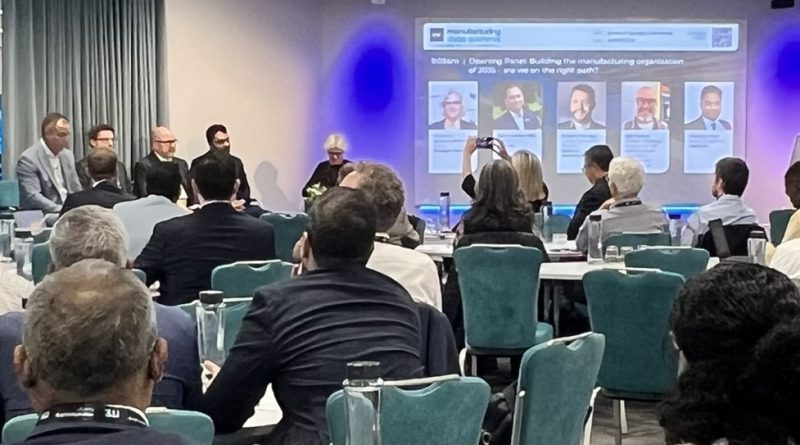
Join manufacturing leaders turning data and AI into business value

The Manufacturing Data Summit UK returns to London on October 6, bringing together manufacturing executives and managers to share how they are turning data, AI, digital transformation and cybersecurity into measurable operational value. At a time when manufacturers are under pressure to make faster decisions about technology investment, governance and risk, the opportunity to learn directly from peers facing the same challenges has become increasingly important.
The market is crowded with new technologies, terminology changes quickly and every function has its own priorities. For leaders responsible for turning digital ambition into operational performance, the real challenge is no longer finding ideas. It is understanding which ideas deserve investment, what foundations have to be in place and how other manufacturers are solving the same problems.
That is the premise behind the Manufacturing Data Summit UK 2026. The event brings together manufacturing leaders working directly with data, AI, digital transformation, operations and cybersecurity to compare approaches, challenge assumptions and share what they are learning in live manufacturing environments. That exchange is becoming increasingly valuable at a point when few organizations can afford to spend years discovering every lesson for themselves.
Manou Campbell, Head of Data & Information Systems at Medik8, captures the importance of peer learning simply: “We don’t know what we don’t know.” He says events of this kind provide an opportunity to hear different ideas, test thinking with peers and take practical lessons back into the business. “More often than not, there’s always at least one, two, three, or four things that I can go away with and explore, find out a little bit more about, and then I end up doing some kind of testing or implementation, or conversation gets driven back in my own team, and we get to explore these ideas.”
From activity to business value
That kind of learning matters because manufacturing has moved beyond the first wave of digital experimentation. AI has created another surge of pilots and proofs of concept, but senior leaders increasingly need to understand what separates an interesting demonstration from something that can be deployed repeatedly, governed effectively and linked to measurable business outcomes.
The summit opens with Ivan Branco, Head of Information Management, AI & Analytics at Volvo Group, examining what separates manufacturers already generating measurable AI value from those still funding experiments that fail to scale. That discussion continues through sessions on where AI investment should go next, what foundations need to exist before projects can move beyond a single site and how leadership should decide whether a pilot deserves to become standard practice.
Campbell will join Walid Hadid, Group Head of Digital & Automation at Weir, and Dr. Slimane Allab, Global Technology Executive and Senior Vice President of Manufacturing at Cognite, for a panel focused on turning AI pilots into enterprise-wide value. Campbell’s own experience points to the need for greater discipline. Manufacturers now have an abundance of potential AI projects, but every initiative should begin with a defined objective, clear success criteria and an understanding of whether AI is actually the right solution.
That distinction matters to managers as much as executives. A senior leader may be deciding where to place the next tranche of digital investment, while an operations or data manager may be deciding which of a growing pipeline of projects deserves scarce technical resource. Both benefit from knowing how other manufacturers are making those choices, what has already gone wrong elsewhere and which approaches are producing measurable results.
The agenda deliberately extends beyond AI because the technology cannot be separated from the quality and ownership of the data beneath it. Gerald Schmidt, Head of Engineering, Digital & Data at DS Smith, and Malgorzata Samuel, Operations Data Standards Manager at BAT, will join Darren Lewis, Senior Data Analyst at Kenvue, to examine what good data governance delivers in commercial terms and how organizations can connect governance, quality and literacy to operational improvement.
Samuel argues that leadership commitment is one of the factors separating organizations able to use data strategically from those that remain fragmented. “Without leadership commitment, data initiatives often remain local projects rather than enterprise-wide transformations,” she says. For an event bringing together decision-makers and practitioners, that relationship between strategy and execution is critical because transformation depends on those setting direction understanding the practical realities faced by the teams expected to deliver it.
Learning across organizational boundaries
One of the persistent challenges of digital transformation is that the problems themselves do not respect departmental boundaries. Data ownership touches IT, operations and business functions, while AI affects engineering, production, workforce planning and governance. Cyber risk moves through suppliers and connected equipment as readily as it moves through enterprise systems, meaning a decision taken within one team can create consequences somewhere else.
The summit reflects that interdependence. Leaders from Coca-Cola Europacific Partners, Electrolux and Johnson Matthey will tackle the realities of IT-OT ownership and accountability, while later sessions move into cybersecurity, digital twins and the relationship between lean manufacturing and digital investment. Rather than examining each technology in isolation, the agenda connects architecture, data, operations, risk and business value.
Paul Knight, Group VP Information Technology and Security at Martin-Baker Aircraft Company, will join the Manufacturing Technology Centre for a discussion on cyber resilience, regulatory readiness and supply chain exposure. Knight argues that resilience can no longer sit solely inside the technology function because the consequences of disruption are operational and commercial.
“Manufacturing organisations are becoming increasingly dependent on data, connectivity, automation and AI to drive efficiency and growth,” he says. “The question is no longer whether a cyber incident will occur, but how prepared the organisation is to continue operating when disruption happens.”
For executives, that means cyber risk needs to be understood alongside production, customer delivery, compliance and investment. For operational and technology managers, it means understanding how controls, supplier decisions and connected systems contribute to the resilience of the wider organization. Bringing those perspectives together is part of the value of knowledge sharing because individual functions frequently see only one part of a much larger problem.
The day also moves from strategic debate into practical deployment. Romi Dhillon, Senior Manager, Digitalization at Edwards, part of Atlas Copco Group, will examine where digital twins create measurable value and where they do not. A later panel featuring Jaguar Land Rover, Minitab and Mars will ask whether digital investment is genuinely making manufacturing leaner or simply adding more activity and complexity.
Peer discussion that goes beyond the stage
Formal presentations are only one part of the value of bringing manufacturing leaders together. Some of the most useful learning happens when delegates can question what they have heard, compare it with their own environment and discover that another manufacturer is wrestling with the same issue.
The Manufacturing Data Summit has therefore built peer exchange into the program rather than leaving it entirely to networking breaks. The afternoon roundtables, held under Chatham House Rules, will allow delegates to explore subjects including data and AI strategy, cybersecurity, proving the value of data investment and avoiding information overload. This format creates space to discuss lessons that are less likely to appear in polished case studies, including what failed, what took longer than expected, where ownership broke down and which assumptions proved wrong.
Campbell believes that direct contact is becoming more important as technology makes it possible for individuals and teams to work increasingly independently. “In this world where we’re more commonly almost isolated because we can do a lot more individually with the tools and tech that we have, something which is going to be ever more valuable is the opportunity to network with peers,” he says.
For a manufacturing executive or manager, the return from attending should therefore be measured by more than the number of presentations watched. It is the opportunity to test an investment decision against another manufacturer’s experience, benchmark data governance against peers, hear where AI is delivering measurable value, question how others are managing cyber exposure and take practical ideas back into the business.
The Manufacturing Data Summit UK 2026 takes place in London on October 6 and is designed for manufacturing professionals responsible for strategy, operations, data, AI, analytics, IT, cybersecurity and digital transformation. Delegates receive access to the full educational agenda, case studies, panels, themed roundtables and networking, creating a full day in which to learn from manufacturers facing many of the same strategic and operational decisions.
Manufacturers cannot remove the uncertainty created by rapid technological change, but they can make better decisions by learning from people already dealing with the same challenges. If you are responsible for turning data and digital investment into measurable operational value, the Manufacturing Data Summit offers an opportunity to compare approaches, challenge assumptions and return to your organization with practical ideas you can act on.
Manufacturing professionals from end-user organizations can now apply for a free delegate pass to attend the Manufacturing Data Summit in London on October 6, subject to approval. The offer is open to mid-to-senior practitioners, managers and technical specialists as well as C-suite executives and senior decision-makers, giving manufacturers across the organization access to the full agenda of keynotes, case studies, panel discussions, themed roundtables and peer networking. Apply now for your free place and join manufacturing leaders sharing practical lessons on data, AI, cybersecurity and digital transformation.
