
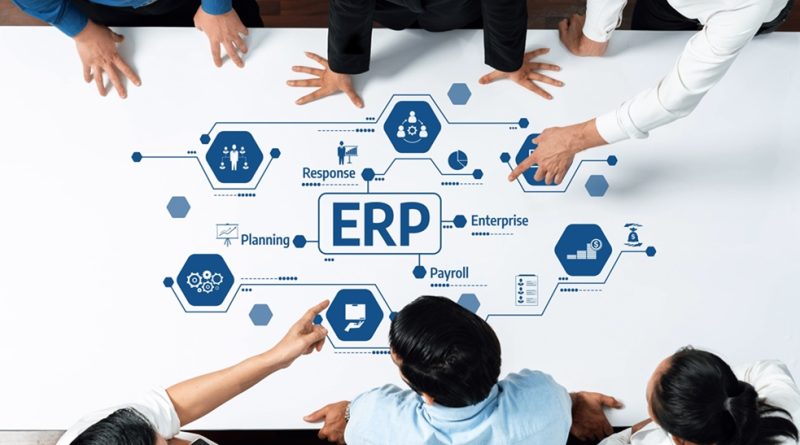
ERP moves from recording the past to guiding the next decision

ERP was built to tell manufacturers what had already happened. Orders were entered, transactions recorded, reports run, and managers looked backwards at performance. That role is now changing as manufacturers ask the same systems to help them interpret what is happening across the business and decide what to do next.
For Mark Feathers, Product Marketing Manager at Epicor, the shift reflects a more fundamental change in what manufacturers expect from enterprise software. Visibility is no longer enough if people still must spend hours working out which issue matters, who will be affected and what action should follow. “Manufacturers need to know what is happening, what needs attention, and what they should do next,” he says. “That information almost needs to be served up to them to enable them to decide and take an action. The value of ERP now is not recording the transaction. It is helping someone decide what they need to do next.”
The difference becomes obvious when something goes wrong. A delayed inbound order used to become visible when a shortage reached the shop floor, but an outcome-driven ERP can connect that delay to the jobs it will affect, identify the customers exposed to disruption and present planners with options while there is still time to respond. That might mean finding another source of supply, rescheduling production or warning a customer before a missed delivery becomes a surprise.
From visibility to intervention
Manufacturers have spent years integrating applications to improve visibility, but adding more connections does not necessarily make the underlying workflow any more effective. The more important question is whether information can move through the business quickly enough to support the next decision.
“The lines are blurring between what would previously have been considered separate parts of the business,” Feathers says. “Rather than purchasing buying the materials, production making the product and logistics shipping it, you can now treat that as a continuous process shared across different departments. The aim is to make that process seamless, irrespective of which application people are using.”
Cloud delivery supports that evolution because manufacturers increasingly expect enterprise applications to be available without carrying the burden of maintaining the underlying technology themselves. The bigger issue, however, is what happens after the applications are connected. Adding another integration has little value if it does not improve how the business responds, and Feathers argues that manufacturers should now be connecting decisions and workflows rather than simply adding more applications to an already complex estate.
For companies that spent the last decade building digital visibility, this represents a change in emphasis. A dashboard showing that an order is late is only the starting point; the useful system is the one that can show what the delay means for production, customers and available alternatives. The challenge is to shorten the distance between recognizing a problem and taking the right action.
AI needs manufacturing context
The practical opportunity for AI is emerging inside everyday manufacturing workflows, from quoting and order handling to planning and customer response, where delays in interpreting information can quickly affect cost and service.
“Manufacturers do not need any more data; they are drowning in data,” Feathers says. “The challenge is how to make sense of that data and understand its context. Where we are seeing AI succeed and scale beyond the pilot stage is where it addresses a real business problem, whether that means providing greater clarity, improving throughput or saving time.”
Epicor is applying that principle through Prism, its embedded AI capability. RFQs are one area where Feathers has seen adoption because the process involves large amounts of repetitive administrative work. Estimating and quoting is another, particularly for engineer-to-order and make-to-order businesses where experienced employees can spend days or weeks assembling a response. The value is not simply automation, but freeing skilled people to concentrate on the exceptions and judgments that are harder to standardize.
For users, embedding AI inside ERP changes the experience from consulting a separate tool to getting assistance within the workflow where the decision is being made. “The biggest differentiator is that Prism understands our ontology,” Feathers says. “If you are talking about a job, it understands that there are operations beneath it, involving subassemblies, parts and machines. A generic assistant does not necessarily understand those relationships. Prism understands manufacturing and the context in which the question is being asked.”
That does not remove the old data-quality problem. Poor ERP data will still produce poor AI outputs, and Feathers is clear that embedded AI does not make that constraint disappear. What changes is the opportunity to apply AI to information that already has a defined business meaning and sits inside an operational workflow, rather than asking a generic model to reconstruct that context from scratch.
Trust decides whether agents scale
The next step is moving from AI that answers questions to agents that support a process. Epicor’s Prism Agent Foundry is intended to let customers and partners build agents around tasks specific to their businesses, while giving them a framework for how those agents are created and deployed. For manufacturers still wondering where AI fits, Feathers believes seeing an agent built around a familiar manual process can make the technology much easier to relate to.
One early adopter demonstrates the point. Feathers describes a family-owned iron foundry in the UK Midlands, established more than two centuries ago, that now runs agents across several areas of its business. Around 70 percent of inbound orders are handled by an agent, leaving sales order staff to focus on exceptions and more complex requests. The example also underlines the importance of leadership, because Feathers says the company’s CEO has been an active supporter of technology adoption.
As AI becomes more deeply involved in operational decisions, the issue shifts from what the technology can recommend to how much responsibility manufacturers are prepared to give it. “Prism can recommend an action, but a human will always sign that action off,” Feathers says. “The aim is to help people work faster, be more productive and make decisions more quickly. It will usually recommend a couple of options, and the user can then select one or decide that a different course of action is needed.”
The bigger barrier may be whether people trust the recommendation at all. Operators have ignored MRP warnings for years when they did not believe the system behind them, and AI will face the same resistance if users do not understand what it is doing or why it has been introduced. Successful adoption therefore depends on explaining how an agent fits into a role, what it can and cannot do, and how it is intended to make the user’s job easier rather than simply imposing another technology from above.
ERP will still record orders, transactions and production events, but manufacturers increasingly expect more from the information those systems hold. As AI becomes embedded into enterprise workflows, ERP can begin to connect events with consequences and consequences with possible actions. The real transition from system of record to system of action will be measured not by how much more data manufacturers collect, but by how quickly people can turn what the business already knows into a better decision.
