
Technology readiness is not manufacturing readiness

A successful demonstrator can prove that a technology works, but that says surprisingly little about whether it can survive the realities of production. Once innovation leaves a controlled environment, it encounters legacy equipment, shift patterns, cybersecurity requirements, quality controls, procurement constraints and operators who need it to work without the developer standing beside them. That gap between technical capability and production capability is where many promising technologies still stall.
Ben Morgan, CEO of the University of Sheffield AMRC, argues that manufacturers need to distinguish far more clearly between technology readiness and manufacturing readiness. The AMRC works with manufacturers to develop and de-risk advanced production technologies and, as part of the wider High Value Manufacturing Catapult, helps bridge the gap between research and commercial adoption. Both were created to help technologies cross the so-called valley of death, but Morgan believes another problem sits at the production end of that journey.
“I would say there is also what I would call the crevice of death at either end of the valley, and you do not really see it,” he says. “Drawing technology out of academia is quite tough and getting it into production is quite tough. You can do a nice technology demonstrator, and it does not go into production, because technology readiness is not the same as manufacturing readiness. Manufacturing readiness is about rate capability, integration with legacy equipment in the production facility and whether people have the skills. Ultimately, it needs to work at two o’clock in the morning on a Tuesday when the developer isn’t standing next to it.”
For manufacturers, proving that an application can perform a task is only the beginning. The harder challenge is making it operate repeatedly, at production rate, within an existing manufacturing system and under the commercial pressures of day-to-day operations. As investment in AI, automation and digital technologies accelerate, that gap between demonstration and dependable production becomes increasingly important.
Production exposes what demonstrations hide
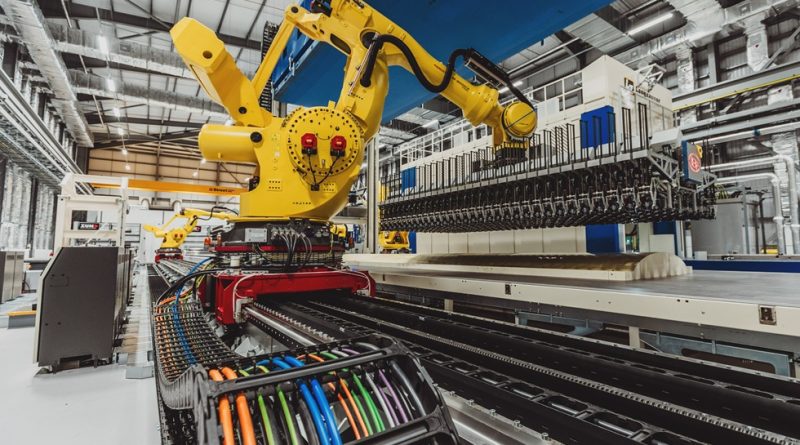
Morgan sees large-scale test environments as one way of closing that gap. The AMRC’s recently launched Composites at Speed and Scale (COMPASS) facility, for example, is being used to develop Boeing’s next-generation single-aisle composite wing manufacturing capability, with the ambition of reducing production time from around 40 hours to four. The significance is not simply the technology being developed, but the ability to test it at a scale and rate much closer to production.
The same principle underpins the AMRC’s long-running work with Rolls-Royce SMR. Morgan says the organization has worked with the business since 2016, helping develop and de-risk the manufacturing processes required to produce small modular reactor modules repeatedly and with the necessary level of assurance. In both cases, the research environment is being pushed toward production conditions rather than stopping once the technical concept has been demonstrated.
“What we are seeing now, and where it needs to go, is setting up production-standard R&D cells,” Morgan says. “That is what you have seen with Compass, it is what we have got in some of our defence spaces, and it is what you are seeing with SMR. At-scale, at-pace infrastructure is critical. Our job is to transfer the R&D into economic growth, so it is R&D into manufacturing capability, into economic growth.”
Even with that infrastructure, moving into production inevitably exposes problems that were less visible during development. Technologies must connect to existing systems, function across different shifts and satisfy requirements from IT, cybersecurity, quality, procurement and finance. Morgan therefore sees organizational alignment as being just as important as the technology itself.
“When you are bringing new technology into production, I think the critical bit is getting all the stakeholders aligned,” he says. “You want the operators bought into how you do it, you want the programming team bought into how it works, and you need IT, procurement and finance involved. When you do have the problems, and it is not if you have the problems, it is when, whether that is shift patterns, legacy machines, cybersecurity or IT, people solve them because they feel some ownership of that technology. Where we have managed to get innovation into production and it is made [1] a big benefit, those groups have all been engaged and they just knock those barriers down together.”
This makes adoption less a final stage of technology development than capability manufacturers must build deliberately. A technically sound system can still fail if the people expected to operate, maintain or support it were not involved early enough.
Start with the manufacturing problem
One reason technologies struggle to scale is that manufacturers can begin with the solution they want rather than the problem they need to solve. AI and automation are particularly susceptible to this because businesses feel pressure to demonstrate that they are investing in new capabilities, even when the proposed application is not addressing the real production constraint.
Morgan says the AMRC routinely encourages manufacturers to step back from the requested technology and examine the end-to-end process before committing to an intervention.
“Very often an SME will come and say, ‘I want to automate this process,’ or ‘I need some AI cleverness in this process.’ The first thing to do is take a step back and look end to end at that process,” he explains. “What we very often find is that the process they are trying to automate is not the best opportunity to drive productivity in the line. It is not necessarily the current bottleneck, and it is not necessarily the best use of automation. Very often we see things upstream that we can change or improve, where improving the quality or consistency of production solves the downstream problem the business was trying to address in the first place.”
The business case can also become distorted when adoption is judged only through immediate payback. Morgan says manufacturers have traditionally expected many technology investments to reach return on investment within around two years, but he is beginning to see more willingness to treat an initial deployment as an opportunity to learn.
He points to an AI vision inspection project with an OEM where the technical capability was not the only obstacle. Regulation moved more slowly than the technology, while the immediate ROI was difficult to justify. The broader value of understanding how the technology could work elsewhere in the organization made the first deployment more strategically important than its narrow financial return suggested.
“I have seen a little bit more leniency on the payback because these are technologies that people want to learn,” Morgan adds. “They may see the financial payback over a three- or four-year period, but they are also seeing the first implementation as a great opportunity to understand how it might affect the rest of the business. Views right from the top of some of these organizations are changing because people know they need to get on board with this, but they need to do it in a controlled manner with something they know works.”
Adoption depends on foundations, not just ambition
AI makes the readiness gap particularly visible because manufacturers can experiment with models relatively quickly while the underlying production data remains fragmented or inconsistent. Morgan argues that many businesses should put less immediate emphasis on AI itself and more on creating data structures that allow new technologies to be deployed repeatedly.
“If I speak to our leading AI engineers and data engineers, they will say most manufacturing businesses need to forget about AI for now and concentrate on data structure and standardization and getting the right ontologies,” he says. “What we are seeing is that those are not consistent, so how you then deploy AI and machine learning is not simple, it is not modular and it is not upgradable. That is where we have concentrated a lot of work: how you collect the data, how it is structured, how it is stored and how it is accessed, so that you can use the right models and make it lightweight, cost effective and production ready.”
The same principle applies to the digital thread. Morgan sees significant potential in connecting information from design through manufacturing engineering and execution, but says the complexity and cost currently mean the strongest examples remain concentrated among larger manufacturers. Even there, technology stacks create technical debt and require continued investment to maintain.
The broader lesson is that manufacturing readiness cannot be added at the end of a successful pilot. It depends on the data architecture, people, business processes, integration capability and production infrastructure surrounding the technology. Without those foundations, manufacturers risk demonstrating increasingly sophisticated technologies without becoming any better at adopting them.
Morgan believes the balance of investment still leans too heavily toward developing technology and not enough toward diffusion and adoption. That does not mean innovation investment should slow; manufacturers still need access to advanced technologies if they are to remain globally competitive. The missing capability is the ability to prove those technologies under conditions that resemble the environment in which they will ultimately have to perform.
“The test beds at scale and rate really are the key to driving manufacturing capability,” he concludes. “That takes us full circle to the difference between technology readiness or technology capability and true manufacturing capability. It is being able to do it, as I say, at two am on a Tuesday morning. That is critical.”
For manufacturers trying to move beyond pilots, that may be the more useful definition of success. The important question is no longer whether the technology works when everything around it is controlled, but whether the organization can make it work repeatedly when everything around it is not.
