
Manufacturing’s next competitive advantage is the ability to experiment

Manufacturers have spent the past decade digitising their operations. Production lines are generating unprecedented volumes of data, dashboards provide near real-time visibility into performance, and artificial intelligence is beginning to uncover patterns that were previously invisible. Yet when it comes to many of the decisions that matter most, introducing a new production line, changing staffing levels, investing in additional automation, altering maintenance strategies or responding to supply chain disruption, organisations still rely heavily on experience, spreadsheets and educated judgement.
According to Tony Smith, Solutions Engineer at Simul8, a Minitab company, manufacturers have reached a point where understanding what happened yesterday is no longer enough. “We’re seeing simulation become a decision-support tool for operational teams,” he says. “It’s about giving people the confidence to ask, ‘what if?’ and understand the likely outcome before making changes in the real world.”
That shift reflects a fundamental change in how manufacturers approach operational improvement. For years, success was measured by how quickly organisations could collect, visualise and analyse production data. Today, the greater challenge is understanding the consequences of change before it affects the factory. Every major decision carries risk. A poorly timed investment can leave expensive assets underutilised. Adjusting production priorities to satisfy one customer may create bottlenecks elsewhere. Reducing inventory could improve cash flow but expose the business to disruption if demand changes unexpectedly. Even relatively small process changes can have unforeseen consequences across an interconnected production environment.
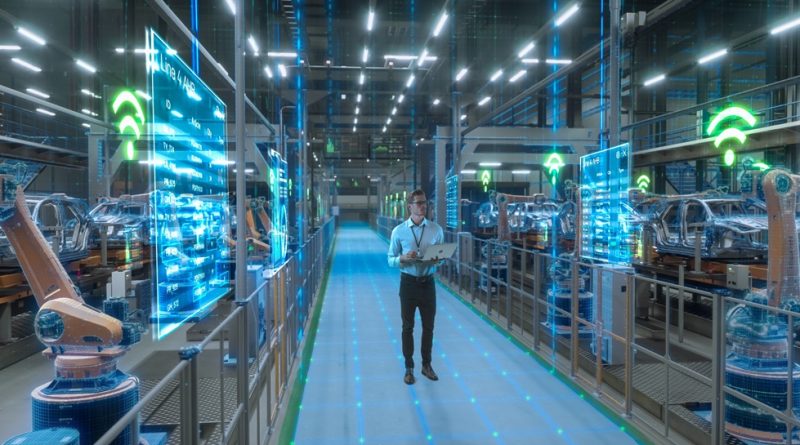
Simulation is emerging as the missing layer in the modern digital manufacturing stack. Data explains the present. Analytics identifies trends. AI recommends possible actions. Simulation allows manufacturers to evaluate the likely consequences of those actions before they are taken, transforming operational improvement from an exercise in judgement into one grounded in evidence. Increasingly, the manufacturers pulling ahead are those able to experiment safely in a virtual environment before committing resources in the real world.
Better decisions begin with better questions
For decades, manufacturers have measured success by how efficiently they could execute a plan. Today, the greater challenge is deciding which plan to execute in the first place. Markets change more quickly, customer demand is less predictable, and production systems have become significantly more interconnected. A decision made to improve one part of an operation can easily create unintended consequences somewhere else.
That is why simulation is beginning to move beyond its traditional engineering role. Once associated primarily with plant design or process modelling, it is increasingly being used to answer practical operational questions that manufacturing teams face every day. What happens if a production line is reconfigured? How will throughput change if staffing patterns are adjusted? Is an investment in additional automation justified, or would a different scheduling strategy deliver the same result? Instead of relying on assumptions, manufacturers can evaluate multiple scenarios before committing resources.
Manufacturing environments rarely stand still for long. Customer demand changes, suppliers miss deliveries, material quality varies and production priorities shift, often within the space of a few days. “Order schedules change, deliveries from suppliers change and the quality of incoming materials changes,” Smith says. “The variables change day to day. You need to understand what happens as those conditions change. Is there going to be an increase in demand? Are bottlenecks going to appear? It’s really about making decisions more quickly, or making decisions before production goes live.”
That represents a subtle but important shift. Rather than reacting to problems after they emerge, manufacturers can begin exploring alternatives while every option is still available. The value lies not simply in identifying the best answer, but in understanding the trade-offs behind each decision. A scenario that maximises throughput, for example, may require additional labour. Another may reduce operating costs but increase work-in-progress inventory. Simulation allows those compromises to be evaluated objectively before they affect production.
The approach also encourages experimentation at a pace that would be impossible on a live production line. Instead of testing one idea over several weeks, manufacturers can evaluate dozens of scenarios in a virtual environment, narrowing the options before implementing the most promising solution. That significantly reduces both the cost and the operational risk of continuous improvement.
The benefits are already extending well beyond traditional manufacturing. One example involved Perfect Company, a software provider serving large quick-service restaurant chains. Working with a customer operating hundreds of locations, the business used simulation to understand how changes to drive-through order prioritisation would affect customer throughput, staffing and service levels. Different operating scenarios could be tested rapidly without disrupting day-to-day operations, enabling the customer to make decisions based on evidence rather than assumption. The project was delivered in just one week and became a long-term decision-support capability rather than a one-off exercise.
Although the application was outside manufacturing, the principle is identical. Whether balancing production schedules, allocating labour, planning maintenance or assessing capital investment, organisations gain a competitive advantage when they can test operational decisions before committing them to the real world.
AI needs somewhere to learn
The growing interest in artificial intelligence is adding fresh momentum to simulation because it addresses one of AI’s biggest challenges in manufacturing: confidence. AI can identify patterns, predict outcomes and recommend actions, but manufacturers are understandably reluctant to allow algorithms to influence production without first understanding the consequences.
Simulation provides the missing layer of validation by allowing manufacturers to test recommendations before they affect production. Instead of implementing an AI recommendation directly on the factory floor, manufacturers can evaluate how it performs under different operating conditions, testing hundreds of possible scenarios without disrupting production. The result is a far more robust decision-making process, where AI generates ideas and simulation assesses their likely impact before changes are introduced into live operations.
The same thinking is also reshaping how manufacturers use digital twins. While the concept has existed for many years, many early deployments focused primarily on monitoring assets or visualising production processes. Today’s digital twins are becoming significantly more dynamic, combining live operational data with simulation models that allow manufacturers to evaluate future scenarios rather than simply observe current performance.
“A traditional digital twin shows you what’s happening on the shop floor,” Smith explains. “But when it’s powered by simulation, you can start planning ahead. If there’s a bottleneck or a machine goes down, you can test different responses before deciding what to do.”
That capability is becoming increasingly valuable as manufacturing operations become more complex. Introducing a new product, increasing production volumes or changing supplier lead times rarely affects a single process in isolation. Decisions ripple through scheduling, inventory, labour, logistics and quality. Understanding those interactions before implementing change significantly reduces operational risk.
The approach is already delivering measurable value in highly complex manufacturing environments. One example involved Keysight Technologies, which wanted to evaluate alternative production strategies without disrupting day-to-day operations. By creating a simulation model of its manufacturing processes, the company was able to assess different staffing models, maintenance schedules, production priorities and capital investment options before committing resources. Rather than relying on trial and error, operational teams could compare multiple scenarios, quantify their impact and identify the most effective course of action with considerably greater confidence.
As AI becomes more deeply embedded in manufacturing, this combination of live data, intelligent analytics and simulation is likely to become increasingly important. Manufacturers will not simply need systems that recommend better decisions. They will need confidence that those decisions will deliver the intended outcome when applied in the real world.
Experimentation becomes part of everyday operations
One of the biggest changes taking place is that simulation is no longer reserved for major capital projects or factory redesigns. Increasingly, manufacturers are using it to support routine operational decisions as production schedules, customer demand, labour availability and supply chain conditions change from week to week.
“People often think simulation is something you use once,” Smith says. “What we’re increasingly seeing is organisations continuing to use it as their operations evolve. New questions come up every day, and they can test those scenarios before making changes in the real world.”
That continuous approach changes the role of simulation. Instead of validating a single investment, manufacturers create a capability that supports ongoing decision making. As new products are introduced, supplier performance changes or production priorities shift, different operating scenarios can be evaluated without disrupting the factory.
The value extends beyond improving individual processes. Manufacturing decisions rarely exist in isolation. Adjusting staffing affects throughput. Inventory policies influence production scheduling. Maintenance strategies impact delivery performance. Simulation enables manufacturers to understand how these interdependencies influence the wider operation before committing resources.
Ultimately, the competitive advantage lies not in collecting more data, but in making better decisions with it. Manufacturers that can test ideas quickly, quantify likely outcomes and understand the trade-offs behind different decisions are far better equipped to respond to uncertainty than those relying on instinct or spreadsheets alone. As operational complexity continues to increase, the ability to experiment safely is becoming as valuable as the ability to execute efficiently.
From hindsight to foresight
Manufacturers have never had more operational data at their disposal, yet data alone cannot reduce risk or improve performance. Competitive advantage increasingly depends on the ability to understand the consequences of a decision before resources are committed and production is affected. Simulation provides that opportunity, allowing manufacturers to move beyond analysing yesterday’s performance to testing tomorrow’s possibilities.
“If you’ve made changes in the past that didn’t deliver the outcome you expected, ask yourself what those mistakes cost,” Smith concludes. “Simulation is about giving you the confidence to explore different options before you make those decisions in the real world.”
The manufacturers pulling ahead will not simply be those collecting the most data. They will be those that have the confidence to experiment, learn and make better decisions before change reaches the factory floor.
