
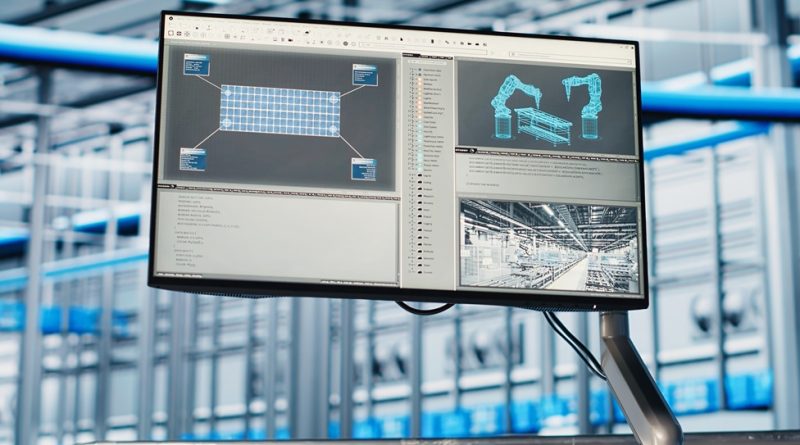
The cheapest production mistake is the one made in simulation

The first collision on a new production line should happen inside a computer model, where a robot can strike an imaginary fixture without damaging the real one. Discovering the same mistake during commissioning could mean broken equipment, engineering rework and a delayed start to production. The difference is not simply the cost of fixing the problem, but how many other decisions have already been made before somebody discovers it.
Manufacturers have used simulation for decades, but its role is expanding beyond validating individual designs. Digital twins, virtual commissioning and AI-assisted engineering are allowing companies to investigate how products and production systems will behave before changes reach the factory floor. The opportunity is to identify decisions that look reasonable in isolation but become expensive when exposed to the constraints of a real manufacturing operation.
Stephen Graham, who was Vice President Product & Technology for Hexagon’s Production Software division for 11 years, believes much of the operational value of industrial AI lies in engineering work completed before machines begin operating. After more than 35 years in industry, including over a decade at Hexagon, Graham has since left the company to undertake postgraduate study at University College London (UCL), exploring the relationship between science, technology and society and the communication challenges surrounding innovation.
His experience in manufacturing has convinced him that production risk frequently originates in design and programming decisions, when potential problems can still be corrected digitally rather than after machinery has started operating. It is an argument that places simulation and engineering verification at the center of efforts to improve manufacturing performance.
The problems that begin before production
An incorrectly selected cutting strategy can create difficulties long before the first component fails inspection. Tool paths, machine geometry, cutting conditions and the sequence of operations all influence whether a part can be produced safely and efficiently. Once the program reaches the machine, discovering an error may require additional setup time or, in more serious circumstances, cause damage to tooling or equipment.
Simulation provides an opportunity to evaluate these decisions while they remain digital. CAM systems can check programmed tool movements against representations of the machine, workholding and component geometry, helping engineers identify potential collisions and other programming problems. Greater model fidelity also allows manufacturers to examine how the actual configuration of a particular machine influences what can be achieved.
Graham sees AI adding value by accelerating established engineering processes without removing the engineer responsible for the result. Hexagon’s ProPlan AI, for example, learns from previous CAM programs and can assist with individual programming tasks using the methods familiar to a particular manufacturing operation. Engineers can review the proposed output at each stage rather than hand over the entire programming process.
That distinction becomes important when assessing the reliability of AI-generated engineering recommendations. “If it gets it wrong once, you can cost hundreds of thousands of dollars on the shop floor,” Graham says. “For anything that’s really going to make a difference, you’re always going to want that verification piece. I doubt we’ll get to the point where we fully delegate responsibility on the shop floor to AI.”
Simulation can provide part of that verification, but it cannot replace sound engineering judgment. Its value depends on whether the model accurately represents the equipment, tooling and operating conditions that the resulting program will encounter.
A production line must work as a system
A robot can complete every movement in its programmed sequence and still fail to perform its intended task when installed alongside other equipment. Physical reach is only one consideration. Material arrival, equipment timing, safety interlocks and the behavior of upstream and downstream machines determine whether individual operations can function together.
Virtual commissioning allows manufacturers to examine these interactions before physical installation or during preparation for startup. Depending on the system, engineers can connect simulated equipment to control logic, test operating sequences and investigate how the line responds when conditions depart from the expected cycle. The objective is to reduce the amount of debugging that must take place while real equipment and commissioning personnel are waiting.
Philippe Bartissol, Vice President, Industrial Equipment Industry at Dassault Systèmes, believes the connection between product engineering and manufacturing engineering is particularly important. A design may be technically correct while presenting difficulties for the equipment expected to manufacture it.
He describes an example involving the placement of fasteners on a component such as a vehicle door. An AI system might propose suitable fastening positions from a product-engineering perspective, but some locations may be inaccessible to the production robot. By working across both product and robot models, an engineering agent can identify those limitations and propose alternatives before the design reaches production.
“You have an agent that is a virtual companion that is both engineering and manufacturing,” Bartissol says. “The fact that it is crossing both areas will make the user much more empowered because it can assist in jobs that previously needed several people in different environments.”
For manufacturers and machine builders, this approach offers a means of identifying disagreements between the intended product and the capabilities of the production system. It also increases the importance of maintaining reliable engineering models and ensuring that information is shared across disciplines rather than confined to individual software environments.
The new machine might not be the answer
Investing in additional automation does not guarantee higher factory output. A machine capable of producing components twice as quickly may simply create larger queues when the next process cannot absorb the additional volume. Similar problems arise when staffing patterns change, maintenance is rescheduled or production priorities are adjusted to satisfy an urgent order.
These are questions for operational simulation rather than conventional machine-level verification. By modeling material flow, resource availability and process variability, manufacturers can compare how proposed changes affect the wider operation. A scenario that improves machine utilization may increase work in progress, while a less aggressive schedule could improve delivery reliability without further capital expenditure.
Tony Smith, Solutions Engineer at Simul8, a Minitab company, sees simulation becoming part of everyday operational decision-making. “We’re seeing simulation become a decision-support tool for operational teams,” he says. “It’s about giving people the confidence to ask, ‘what if?’ and understand the likely outcome before making changes in the real world.”
The benefits become particularly apparent when different departments assess the same proposal. Production may want to maximize throughput while maintenance needs access to equipment and planning must protect customer commitments. A shared simulation allows the consequences of each option to be examined against the performance of the wider manufacturing system.
Smith points to work with Keysight Technologies, where simulation was used to evaluate alternative manufacturing strategies involving staffing, maintenance and production priorities. Such applications demonstrate how experimentation can extend beyond factory design into recurring operational decisions.
Manufacturers can also test scenarios that would be impractical or costly to reproduce physically. A supplier delay, temporary equipment failure or substantial change in demand can be introduced into a model without interrupting production, giving teams an opportunity to assess possible responses before those conditions occur.
The model is only as convincing as its assumptions
An immaculate digital representation of a factory can still produce misleading answers when it fails to reflect what happens in the physical operation. Machines deteriorate, products change and processes behave differently under varying conditions. A model developed around nominal cycle times and ideal equipment availability may substantially overestimate the performance that the factory can achieve.
The level of detail required depends on the decision being investigated. A high-level model may be sufficient to compare alternative factory layouts or staffing arrangements, while virtual commissioning of complex automation demands a more detailed representation of equipment behavior and controls.
Bartissol argues that manufacturers gain greater value when digital models capture meaningful relationships and can be used for experimentation. “The virtual twin is structured. It has a structure that has meaning, and you can add to it, retract from it and simulate,” he says. “The simulation is bringing everything. Virtual means that you can simulate it, whereas digital, in most cases, is static.”
Building that representation also raises commercial questions. Machine builders may be reluctant to share detailed models containing proprietary engineering knowledge, while manufacturers need enough information to validate how equipment will operate within a complete production system. Agreements concerning model access, accuracy and maintenance can therefore become important parts of a digital engineering project.
Models also require continuing validation against physical results. Engineers should compare simulated cycle times, bottlenecks and equipment behavior with actual production, investigate significant differences and update assumptions when operating conditions change. A simulation that was accurate during commissioning should not automatically be trusted several years later.
A safer way to make manufacturing decisions
AI is increasing interest in simulation because manufacturers can now generate recommendations faster than they can safely implement them. Software may suggest changing a production schedule, modifying a machining strategy or reconfiguring equipment, but a plausible recommendation is not evidence that the resulting process will work.
Testing those proposals within an appropriate model offers another layer of engineering assurance. The model can expose constraints that the AI did not consider and allow alternatives to be compared before production is affected. Human approval and conventional safety controls remain essential, particularly where changes could affect physical equipment or personnel.
The business case should ultimately be measured through avoided commissioning delays, reduced engineering rework and improvements in production performance. Simulation projects need to demonstrate that their findings influence real decisions, not merely produce increasingly detailed digital representations.
For manufacturers, the most valuable outcome may be a change in when engineering problems are discovered. Physical commissioning, trial production and continuous improvement will always reveal issues that cannot be anticipated perfectly. But when a manufacturer can test an idea, expose its weaknesses and correct the design before equipment or material is committed, the cost of being wrong becomes considerably easier to manage.
