
When robots stop being fixed automation

Industrial automation has always been most effective when the world around it behaves exactly as expected. The difficulty is that much of manufacturing and logistics does not. Materials arrive out of position, floors become slippery, trailers are packed inconsistently and equipment must be inspected in spaces designed for people. Physical AI is beginning to make those variations part of the problem a robot can handle rather than the reason automation stops.
Aya Durbin, Director of Product – Atlas at Boston Dynamics, sees the brownfield reality of manufacturing as an important backdrop to that change. Existing plants and warehouses have been built around people, legacy equipment and production processes that cannot simply be moved aside for a new automation project. For many manufacturers, the choice is therefore between finding a way to automate within those constraints or leaving difficult work manual.
“The fundamental shift is the ability to apply automation in difficult, dangerous or unstructured environments,” Durbin says. “Traditional manufacturing automation requires rigid, highly structured spaces where every variable is controlled. By contrast, mobile robots equipped with advanced perception and intelligence can navigate the real world, which is inherently unpredictable.”
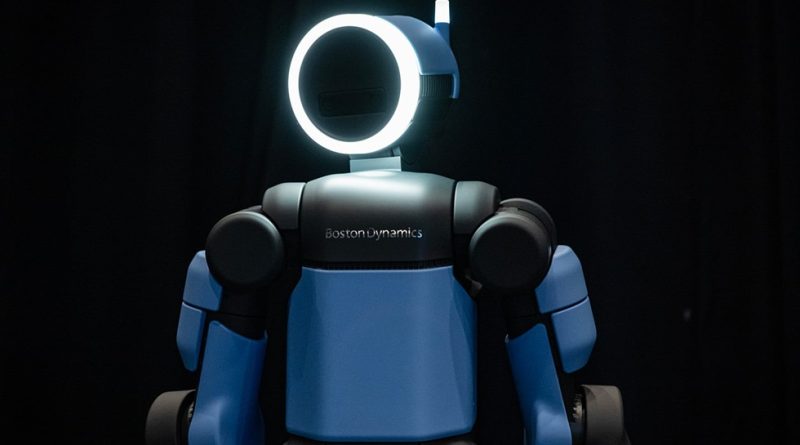
Boston Dynamics’ current portfolio illustrates how different forms of mobility address different industrial constraints. Spot can move through facilities to conduct inspections, Stretch can enter existing floor-loaded trailers, and Atlas is being developed for manufacturing tasks in spaces originally designed around human movement. The common thread is not the shape of the robot, but its ability to function when the environment cannot be reduced to a perfectly repeatable sequence.
Automation moves into the messy parts
Physical AI also changes the development cycle behind robotic behavior. Industrial environments expose machines to combinations of movement and variation that are difficult for engineers to anticipate one scenario at a time. Engineers therefore need a way to train for conditions that may be difficult or impractical to reproduce repeatedly in a live facility.
“Robots are becoming the physical embodiment of AI,” Durbin says. “For manufacturers, impressive behaviors that used to take engineers months of programming and testing can now be accomplished overnight. We use reinforcement learning to improve the way Spot robots walk over slippery surfaces in facilities such as breweries or food processing plants. We put the robot through thousands of simulated attempts in a matter of hours to master its balance, and once perfected, deploy that capability through a software update.”
For manufacturers, brownfield deployment is also a capital allocation question. Reconfiguring a working plant can require building work and production downtime before the robot creates any return. That can rule out otherwise valuable automation in mature facilities where the surrounding operation is difficult or expensive to change.
“We design the robots to adapt to the facility rather than forcing the facility to adapt to the robot,” Durbin says. “Spot autonomously navigates factory floors to conduct inspections and capture data for predictive maintenance. Stretch drives directly into existing floor-loaded trailers to unload boxes regardless of the configuration, while Atlas uses a humanoid form factor because industrial environments were built for humans.”
Inspection is one of the clearest examples of that model already operating at scale. Mobile robots can repeatedly follow routes through industrial facilities, carrying sensors into areas that are time-consuming or hazardous for employees to inspect manually. At Michelin, Spot monitors more than 700 pieces of equipment and generated 72 work orders for overheating equipment and air leaks during its first few months, while at Cargill a robot identified a centrifuge air leak within minutes of being deployed.
The value is not simply collecting more data. Repeated inspection can create a more consistent picture of asset condition and allow small anomalies to be investigated before they become major failures. It also changes the role of human inspectors by moving routine data collection away from employees while leaving diagnosis, maintenance decisions and corrective work with people.
Variation is the opportunity, not the exception
Logistics exposes a different problem because the work itself can change from one load to the next. Boxes shift during transport and stacks collapse, so the arrangement inside a trailer rarely matches an idealized pattern for long. Trailer unloading is a useful test for adaptive automation because uncertainty effectively arrives with every vehicle.
“A traditional robot following a predetermined sequence will fail the moment a box is not exactly where it is supposed to be,” Durbin says. “Because Stretch uses advanced autonomous perception, it can look at a messy, unpredictable wall of boxes, calculate the best approach in real time and continue unloading hundreds of cases per hour without human intervention.”
The same principle is beginning to influence manufacturing applications where part presentation, reach requirements or task sequences are difficult to constrain. Atlas is transitioning into production with an initial focus on activities such as part sequencing and machine tending, alongside assembly work that is difficult to automate with conventional equipment. Boston Dynamics is targeting work with demanding ergonomic requirements or persistent labor challenges rather than routine tasks already well served by fixed machinery.
As Atlas moves toward production, the humanoid form factor will inevitably be compared with technologies manufacturers already understand well. The commercial question is not simply whether a humanoid can perform a task, but whether its flexibility creates enough value to justify a more capable machine. That puts the burden on humanoids to solve work that existing automation handles poorly rather than compete everywhere.
“Conventional, fixed automation will continue to make the most sense for high-speed, perfectly uniform, single-task repetition where the environment never changes, like stamping metal or capping bottles on a controlled conveyor,” Durbin says. “Humanoids will step in to fill the gaps wherever a task requires a machine to move through a dynamic physical space, adapt to its surroundings and interact with variable objects.”
Atlas is humanoid in form but is not intended to imitate human motion unnecessarily. Its electric actuators and range of motion allow it to move in ways a person cannot, so the design can exploit an environment built for people without being limited to human biomechanics. The commercial case will depend on whether that combination of versatility and non-human movement can solve work that remains awkward for conventional machines.
Scale needs more than a capable robot
The software-like pace of capability development meets a much more physical reality once robots share space with people. A new behavior can be distributed digitally, but its consequences unfold through a moving machine with mass and momentum. Functional safety therefore has to evolve alongside capability rather than be treated as a separate exercise.
“The rapid advancements in this field mean you can deploy new policies onto robots faster than ever before, and if you are not careful that can create issues around functional safety,” Durbin says. “If there is an emergency and a robot needs to be immediately shut down, you cannot just cut power and let it crash to the floor. We have to think about how a robot gets to the ground in the safest way possible.”
A successful deployment at one location also says little about whether a manufacturer can operate dozens of intelligent robots across several facilities. The challenge changes when robots must be replicated, coordinated and supported across sites with different layouts and processes. Scaling therefore tests the manufacturer’s own operating model as much as the robot itself.
“One of the largest barriers to scale is data infrastructure,” Durbin says. “You cannot go from zero to a humanoid overnight. Humanoids will be most effective if they are deployed with in-depth models of a facility and lots of data about how it operates. The companies that will crack the code on humanoid value first are the ones already investing in mobile robotics and other AI solutions today.”
The workforce transition will develop alongside that infrastructure. Employees will increasingly need skills in robot maintenance, model training, work-cell setup and fleet management, while people remain responsible for identifying suitable tasks and maintaining safe operating practices. Physical work may reduce in some applications, but deploying robots at scale creates new work around directing, supporting and improving the automation itself.
Over the next several years, Boston Dynamics expects robotics to move from isolated task-specific deployments toward broader fleets operating in dynamic industrial environments. The more important change for manufacturers may be conceptual: automation will no longer have to begin by eliminating every source of variation from the task. Fixed automation will remain indispensable where speed and uniformity dominate, while physical AI expands the territory in which automation can compete. The factory of the future may therefore depend less on building perfect environments for machines and more on building machines capable of working in the imperfect environments factories already have.
