
Predictive quality starts before the defect appears

Manufacturers have traditionally treated quality as something to verify once a product has been made, but by the time inspection finds the defect, much of the cost has already been incurred. Advances in edge computing, machine vision and AI are creating an opportunity to move quality further upstream, identifying the conditions that lead to failure before bad parts begin leaving the process.
For Erin Barrett, President and CEO of Eigen Innovations, the shift is less about replacing conventional inspection than giving manufacturers the ability to intervene earlier. Most quality failures, she argues, do not appear without warning because changes in the process often begin well before the finished product moves outside specification.
“We find most problems have early indicators,” Barrett says. “Usually, there are things happening in the process, process drift that you can actually pick up before actual costs or defects hit the operations. The sooner you can get that problem identified and fixed, obviously, the better your P&L looks and the more competitive advantage you have.”
The challenge is turning those early signals into something operators can understand and act on. A camera may determine that a part is defective, but that alone does little to explain why the problem happened or what needs to change to prevent the next one.
See the process, not just the defect
Connecting visual inspection with information from the manufacturing process can turn quality data from a verdict into a troubleshooting tool. Temperature, cycle conditions and PLC data can provide the context needed to identify when a process is moving toward what Barrett describes as the “danger zone” before it begins producing unacceptable parts.
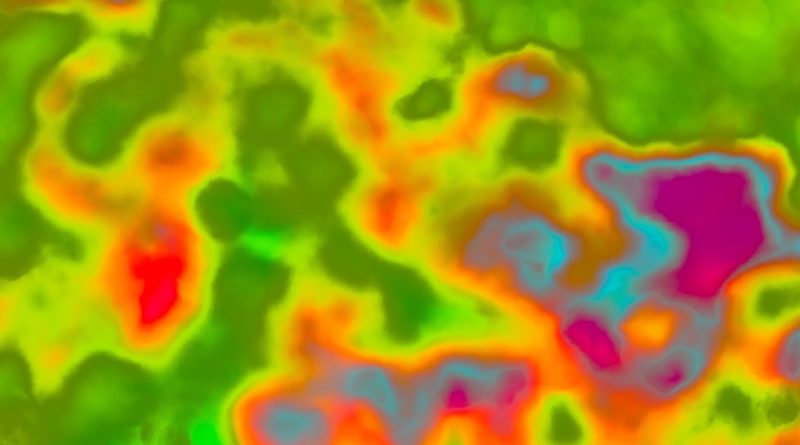
Thermal imaging is particularly useful where temperature consistency affects product quality, and Eigen has focused its OneView platform on applications across plastics, metals, building materials and food.
“Instead of just getting a value of the temperature of a product or an asset, you’re actually getting a continuous stream of thermal images, and you get a story versus a point in time,” Barrett says. “The system continuously learns and adapts, so it’s looking for things that look unique and flagging when something out of the norm happens.”
The advantage becomes clearer in processes where defects become visible only after the conditions that created them have passed. In extrusion blow molding, for example, impurities or process variation can eventually create structural or cosmetic problems in the finished product. Traditional sampling may find the problem only after material has been processed, cooled and inspected.
Monitoring the parison as it is extruded gives manufacturers another option. Real-time thermal imaging can expose variation earlier, allowing the process team to investigate before the problem is locked into the finished component.
Similar patterns appear elsewhere. Barrett describes wallboard manufacturing, where small pockets of air can develop into larger voids after the board is formed. Historically, manufacturers might not discover the problem until the board was cut and samples were inspected further downstream.
Now, subtle changes can be detected earlier in the process. That information can give operators an opportunity to adjust the recipe before the variation becomes a larger quality problem.
The same principle can also apply to assets rather than products. A partially blocked pipe, for instance, rarely moves instantly from normal operation to complete failure. Small changes can appear days before downtime, creating a window in which maintenance can intervene.
Turn warning signs into action
Finding an anomaly early is useful only if manufacturers can distinguish a genuine problem from normal process variation. Production environments change constantly as products, materials and operating conditions vary, making excessive false alarms one of the quickest ways to undermine confidence in an AI system.
Acceptance thresholds therefore need to reflect the application. Barrett says some customers deliberately alter inspection severity for different SKUs because the acceptable level of variation changes with the product and its associated risk.
One of the biggest risks in production is treating an AI vision system as a finished installation rather than something that must remain aligned with the process as conditions change. “It’s not a set it and forget it paradigm,” Barrett says. “It’s a continuous learning platform that can get smarter over time, so long as you care and feed it. They understand they have a role to play in that to ensure that happens.”
That human involvement becomes particularly important when a system moves beyond generating alerts and begins influencing the production process directly. Eigen already uses applications where AI-generated triggers can instruct a PLC to remove a product or stop a line when a defined level of severity is reached.
In less severe situations, operators remain in the loop and decide what action to take. Moving toward greater autonomy therefore becomes as much a question of trust as technical capability. “We’re pretty keen on pushing for automation where it’s possible,” Barrett says. “In a lot of our applications we have warning signals that don’t do an automatic thing without a human in the loop. But if it gets to a certain level of severity, we’re sending a trigger to a PLC to either remove the product from the line or stop the line.”
Experience has taught Barrett that this trust can determine whether an AI pilot becomes a production system. Early projects struggled not because the underlying technology failed, but because operators were being asked to rely on decisions generated by a system they could not easily understand.
Making AI more transparent became central to the deployment process. Engineers need to see enough evidence behind a recommendation to judge whether the system is behaving reliably, particularly when production performance and personal reputations are at stake.
Quality becomes a process problem
Predictive quality also changes the relationship between quality and production teams. These groups have traditionally worked with different information and often become involved at different points in the process, but earlier intervention forces the two perspectives closer together.
Rather than sorting defective parts after production, teams begin asking what is changing inside the process and how that variation can be corrected. Barrett has seen technology become a common source of evidence around which process and quality specialists can collaborate.
That evidence becomes more valuable when it forms a continuous digital history. Linking product images with relevant process data gives engineers a record of what was happening before, during and after an event, making it easier to investigate root causes or defend product quality when a claim occurs.
Some manufacturers, Barrett says, describe this record as the “voice of the process.” It replaces the task of piecing together information from disconnected systems with a more complete narrative of how production behaved.
The value can be significant when something goes wrong. Manufacturers that previously spent weeks gathering records to investigate a recall or customer claim can potentially reduce that work to minutes when the relevant process and quality history is already connected.
Technology alone, however, will not move quality upstream. Barrett believes the technical capability to monitor processes continuously, identify early warning signs and automate responses already exists. The harder barrier is whether manufacturers are willing to rethink familiar ways of working. “I think the only thing that’s getting in our way at this point is the mindset,” she says. “The set it and forget it mentality, manual tasks, isolated troubleshooting. Just take a step back and say, ‘What if we could do it differently?’”
That change cannot depend on an isolated engineer trying to push a pilot through the organization. Moving from inspection toward predictive quality requires support from leadership and a willingness across the plant to treat AI as part of the production system rather than another experiment running alongside it.
For manufacturers that make that shift, quality begins much earlier than the inspection station. The most valuable signal may no longer be the one that identifies a bad part, but the one that gives the factory enough warning to avoid making it in the first place.
