
Rockwell’s Singapore Lighthouse shows what scaling industrial AI really takes

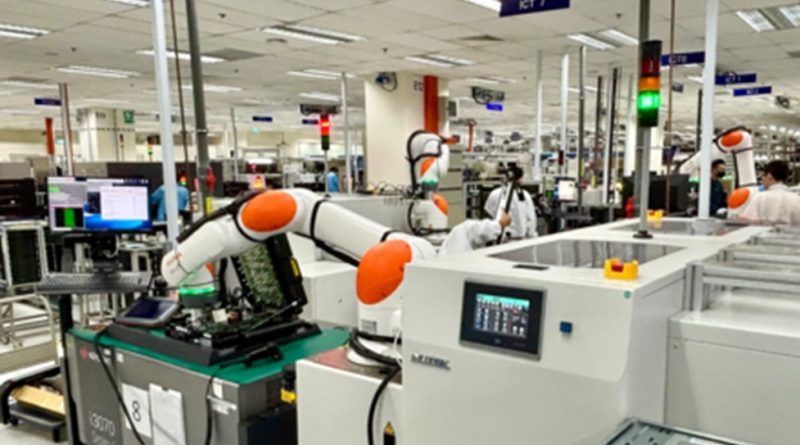
Rockwell Automation’s Singapore factory does not resemble the sprawling industrial sites commonly associated with advanced manufacturing. Built into an urban office environment where land is scarce, production is spread across several floors, creating unusual constraints around the movement of materials and people. Yet this unconventional facility has become one of the World Economic Forum’s Global Lighthouse sites, recognized for applying digital and AI-enabled technologies at scale.
Pit Wee Yeoh, vice president of manufacturing operations for Asia Pacific and EMEA at Rockwell Automation, has led much of that transformation. For him, the significance of the recognition lies less in the badge itself than in what it says about the maturity of industrial digitalization. Technologies that only a few years ago were being tested as proofs of concept are now becoming part of live production.
“Smart manufacturing and digital transformation are no longer proof-of-concept activities,” Yeoh says. “We are scaling a large number of use cases across the enterprise and across the factory floor. That is very different from a few years ago, when many AI and advanced automation projects were still at the proof-of-concept or proof-of-value stage.”
Singapore’s manufacturing challenge is shaped as much by its physical constraints as by its scale. Production is spread across several floors in an urban facility, while employees support more than 100 types of machines across a substantial product portfolio. That creates a demanding environment for both day-to-day operations and the people expected to build expertise across very different equipment and processes.
“We did not start this journey with the Lighthouse in mind,” Yeoh says. “We started by asking how we could use technology and upskill our people to address business pain points. We wanted to improve productivity, reduce the complexity of high-mix, low-volume manufacturing and make it easier for people to become competent in an increasingly complex environment.”
Start with the work people struggle to do
One of the clearest examples came from maintenance, where the variety and age of equipment made knowledge difficult to acquire and distribute. New technicians could spend months learning how different machines behaved, where documentation was stored and what previous repair records could tell them about a fault.
Maintenance knowledge was one of the areas where Rockwell saw the biggest gap between experienced technicians and newer employees. With more than 100 types of machines in the facility, much of the expertise needed to diagnose faults had historically been built up through time, familiarity and repeated exposure to previous problems.
“A technician used to see an error code and then have to find the correct manual, read through the documentation and work out what was relevant,” Yeoh says. “That could take hours. Today, the technician can describe the machine and the symptom, and the system can identify the likely issues, suggest what to check and bring up the right pages of documentation within seconds.”
The technology has also changed onboarding. Yeoh says some complex maintenance roles previously took about nine months to reach basic competency, whereas AI support and redesigned training have reduced that to around three months. New employees are introduced to the tools during orientation rather than being expected to build most of their knowledge from documentation and experience on the shop floor.
As technicians began using the maintenance copilot in live production, the limitations of the early models became impossible to hide. Recommendations were not always as accurate as those from experienced employees, and confidence could fall quickly when the system produced the wrong answer, making change management as important as the technical work required to improve the model.
“We learned that change management has to start at the same time as the technology,” Yeoh says. “You must explain that an AI model may take three or six months of iteration before it becomes smart enough for the environment. Initially, we did not manage that expectation well. People expected it to work from day one, saw mistakes and decided it was wasting their time. We had to recover from that by creating clear ownership and an improvement process.”
Two years into the program, Yeoh says the maintenance AI is now more accurate in some situations than many experienced technicians. Trust was not created by announcing the capability, however. It developed as employees saw the system improve and became part of the process that made it more useful.
Move intelligence into the work
The Singapore program has also changed how engineers respond when quality begins to drift. Skilled staff traditionally spent considerable time assembling information and narrowing down possible causes before they could begin fixing the underlying production problem. Rockwell has used real-time production data and AI agents to reduce that preparatory work.
A monitoring agent watches process results across critical operations. When it detects an abnormal trend, the information can be passed to a diagnostic agent that compares the event with historical defect and repair records before sending an initial assessment to the engineer.
“In the past, the engineer had to detect the problem, prepare the report and segment the data before getting to the real troubleshooting,” Yeoh says. “Now the AI does that preparation. When the engineer reaches the line, the information is already on the phone or tablet, so the skilled professional can focus on fixing the problem.”
AI continues working after the intervention. Instead of an engineer remaining beside the machine to watch subsequent units and confirm that the corrective action worked, the monitoring agent can track the process and alert the engineer if the problem returns.
The result is that more engineering time can be directed toward diagnosis and corrective action rather than assembling information or waiting to see whether an intervention has worked. Yeoh says the site has reduced scrap and repair hours significantly, with AI able to recognize unusual patterns before defect levels become large enough to attract human attention.
“In the past, you might wait until the abnormal result accumulated to the point where it showed up clearly in the data,” he says. “AI does not have to wait for 20 percent or 5 percent defects. It can compare what is happening with historical data and identify that something unusual has happened twice in a row. The response time is much faster because it is watching continuously.”
Singapore’s experience therefore moves the discussion beyond whether a factory has dashboards or connected machines. The more significant change comes when intelligence is placed inside operational workflows and gives employees something they can act on while there is still time to influence the outcome.
Scale must be designed in
More than 50 digital and AI-enabled use cases have been deployed at the Singapore site, but a successful application inside one factory is not necessarily evidence that it can travel. Manufacturing pilots often become dependent on local equipment or specialist knowledge, making them difficult to reproduce when another plant tries to adopt them.
Many manufacturing pilots work because they have been built around the particular conditions of one machine, line or site. The difficulty appears when another plant tries to adopt the same idea and discovers that the original solution depends on local data structures, bespoke integrations or technology that does not exist elsewhere.
“When somebody proposes a use case, the ability to scale is one of the criteria for investment,” Yeoh says. “We must develop it on a common architecture and a common data foundation, using the company’s standard technology stack. If you build something that only works on one machine or in one plant, it becomes much harder to take it anywhere else.”
Scaling also depends on plants being willing to adopt something they did not develop themselves. A site elsewhere in Rockwell’s network may know little about the conditions in Singapore, so confidence must come from a consistent process rather than familiarity with the original project.
“Governance creates confidence and trust,” Yeoh says. “Another part of the organization can know that the use case went through the governance process, used the standard structure and data foundation, and did not introduce unnecessary risk. That makes it much easier to scale.”
Many Singapore use cases are already being implemented elsewhere in Rockwell, particularly capabilities based on large language models, machine vision and agentic AI. The factory has also become a place where manufacturers and students can see those applications operating in production rather than as demonstrations, with Yeoh estimating that around 1,500 visitors passed through the site during the previous 12 months.
The wider lesson is not that every manufacturer should copy the individual technologies deployed in Singapore. The experience suggests that industrial AI becomes scalable when it starts with an operating problem, is built so another site can reuse it and earns the confidence of the people expected to work with it.
“Technology is ready, but people have to be at the front and center of the transformation,” Yeoh says. “We have to bring people up to speed, build trust and show that the technology is there to augment their capability and reduce the complexity of the job rather than threaten it.”
That offers a more useful interpretation of Lighthouse status than the number of advanced technologies a factory can display. The real benchmark is whether those technologies have become part of normal manufacturing work and whether the improvement can be repeated elsewhere without rebuilding the transformation from the ground up.
