
Industrial AI needs more than data to understand the factory

Manufacturers are being asked to move quickly on industrial AI, but enthusiasm is colliding with a familiar operational reality. Factory data is fragmented; production systems are complex and much of the knowledge needed to make good decisions sits inside engineering models and the experience of people on the plant floor. For AI to become useful in production, it needs more than access to data. It needs context.
For Philippe Bartissol, Vice President, Industrial Equipment Industry at Dassault Systèmes, the challenge is not simply giving AI access to more manufacturing data. It is giving the technology a reliable understanding of the environment in which decisions are being made.
“AI applied to scientific-based and structured models will work much faster and will be much safer and much more consistent,” Bartissol says. “We want to apply AI agents to models of the product being made and of the production line at the same time. If you apply specialized agents in engineering and manufacturing in this context, you will have much more precise answers based on scientific knowledge.”
From generic AI to industrial context
Industrial environments leave little room for plausible but incorrect answers. In engineering and manufacturing, AI may be asked to recommend a design change or determine whether a production line can handle a new product configuration. The usefulness of the answer depends on whether the system understands the physical constraints surrounding the task.
Dassault Systèmes is developing specialized AI agents for different roles on its 3DEXPERIENCE platform. Bartissol highlights Leo, an engineering and manufacturing agent designed to work across both domains. The aim is not simply to answer questions, but to reason across product and production models and use existing engineering knowledge to support a task.
One example is the placement of fasteners on a component such as a car door. An AI agent could determine an optimum set of fastening points, but the engineering answer is incomplete if the production robot cannot physically reach some of those locations. Bartissol says the agent can combine knowledge of the product with the robot model and path calculation to identify unreachable points and propose alternatives.
“You have an agent that is a virtual companion that is both engineering and manufacturing,” he says. “The fact that it is crossing both areas will make the user much more empowered because it can assist in jobs that previously needed several people in different environments. The task can be assisted, but you need agents that are specialized and working on previous knowledge.”
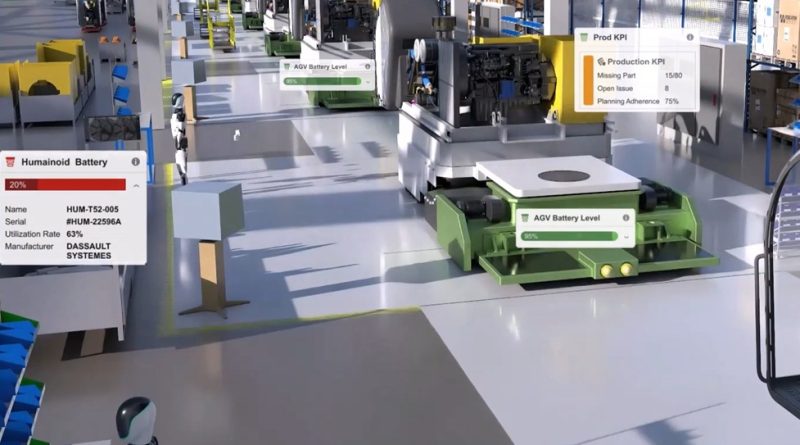
Bartissol also draws a clear distinction between a virtual twin and a conventional digital representation of an asset. “The virtual twin is structured. It has a structure that has meaning, and you can add to it, retract from it and simulate,” he says. “The simulation is bringing everything. Virtual means that you can simulate it, whereas digital, in most cases, is static.”
Seeing inside the production system
How much manufacturers can learn from a virtual twin depends heavily on the level of detail built into the model. A production line can be represented at a high level, with each machine treated as a box with an input and an output, which may be sufficient for flow optimization but reveals little about what is happening inside the equipment itself.
Bartissol argues that a multiscale virtual twin can go further by allowing manufacturers to move from the overall line into individual machines and specific assemblies. That makes it possible to examine behavior before changes are made on the physical line, including through virtual commissioning.
Shorter production runs and more frequent changeovers are increasing the pressure on manufacturers to validate changes without disrupting live operations. “If you are able to simulate the next production run on the twin, then you will save a lot of time and also non-quality output,” Bartissol says. “If we could have an agreement between machine makers and line users so that we have a complete virtual twin of the line, then I think production will be much easier.”
That ambition exposes one of the harder barriers to creating a complete manufacturing model: intellectual property. Machine builders may be reluctant to provide customers with detailed models of equipment because those models contain valuable proprietary knowledge. Plant operators, meanwhile, gain more value from a virtual twin when they can look beyond the machine as a black box.
Bartissol points to tire manufacturing as one example where the problem can be easier to solve because manufacturers may design or build more of their own production equipment and therefore own the relevant intellectual property. In other sectors, he sees a need for agreements between line users and machine builders that allow enough model information to be shared while protecting proprietary knowledge.
Once the model exists, AI can use it to expand the range of scenarios a manufacturer is able to test. Rather than replacing simulation, Bartissol sees AI as a way to explore more configurations and increase the scope of validation.
Autonomy changes the orchestration problem
The next layer of complexity comes from the increasing autonomy of factory equipment. Traditional robots are largely programmed to execute predefined tasks in controlled environments. Bartissol expects perception and AI to make production equipment more responsive to what is happening around it.
A picking robot, for example, may have to identify an object arriving at an unpredictable position on a wide conveyor, determine its orientation and decide how to grasp it. Autonomous mobile robots face a similar challenge because they must combine their assigned mission with information sensed from the surrounding environment.
This changes the orchestration challenge inside the plant. Manufacturing execution systems have traditionally passed production instructions through relatively deterministic layers of control. As more autonomous machines and robots begin making local decisions, manufacturers will need to determine how that autonomy fits into the wider production system.
“Manufacturing is becoming super interesting, but also complex because these are new technologies and new cultures,” Bartissol says. “You need people that are able to blend both worlds. If a company can really master this, it will bring a lot of flexibility to the production system.”
He expects this to strengthen the case for a common industrial architecture rather than separate virtual twin and AI initiatives. In Dassault Systèmes’ view, the product model and production model should sit within an environment where simulation and AI agents can work across both, allowing the impact of a change to be understood across engineering and manufacturing.
For companies at an earlier stage, Bartissol’s recommended starting point is more fundamental. He says manufacturers should begin by modeling the production line and manufacturing processes in as much useful detail as possible. The more complete that foundation becomes, the more options manufacturers create for simulation and, later, more autonomous production.
Keeping the twin aligned with the factory is another challenge. Production lines evolve as equipment and control systems are changed, so a virtual twin that is not maintained will gradually diverge from the real plant and lose value.
Keeping the virtual twin synchronized with the physical plant presents another challenge, especially as production lines are modified over time. “It is super important to have a virtual twin that equals what is right in front of your eyes on the line,” Bartissol continues. “If a field technician has modified a complete line, based on the technician reports we should be able to propose a modification of the virtual twin, and then a human being would just say yes or no. For this, AI can help a lot.”
For manufacturers, the implication is that progress will depend less on adding AI in isolation and more on improving the quality of the industrial environment in which it operates. “There is a lot of hype and a lot of expectation that AI could reconstruct this out of the blue. I don’t think that will be the case,” Bartissol concludes. “AI will be much more relevant based on a scientific base, and that scientific base is a virtual twin that can be simulated.”
For manufacturers trying to move AI from experimentation into production, that changes the order of priorities. The immediate challenge may not be finding another model or adding another AI tool. It may be building the structured industrial context that allows AI to understand what the factory is doing.
